On this page
Intermediate SIV maneuvers represent the boundary between standard piloting and complete dynamic control of the wing. At this stage, maneuvers are no longer just "defensive"; they become active tools for managing extreme situations.
Here is an in-depth and detailed breakdown of the Intermediate maneuvers:
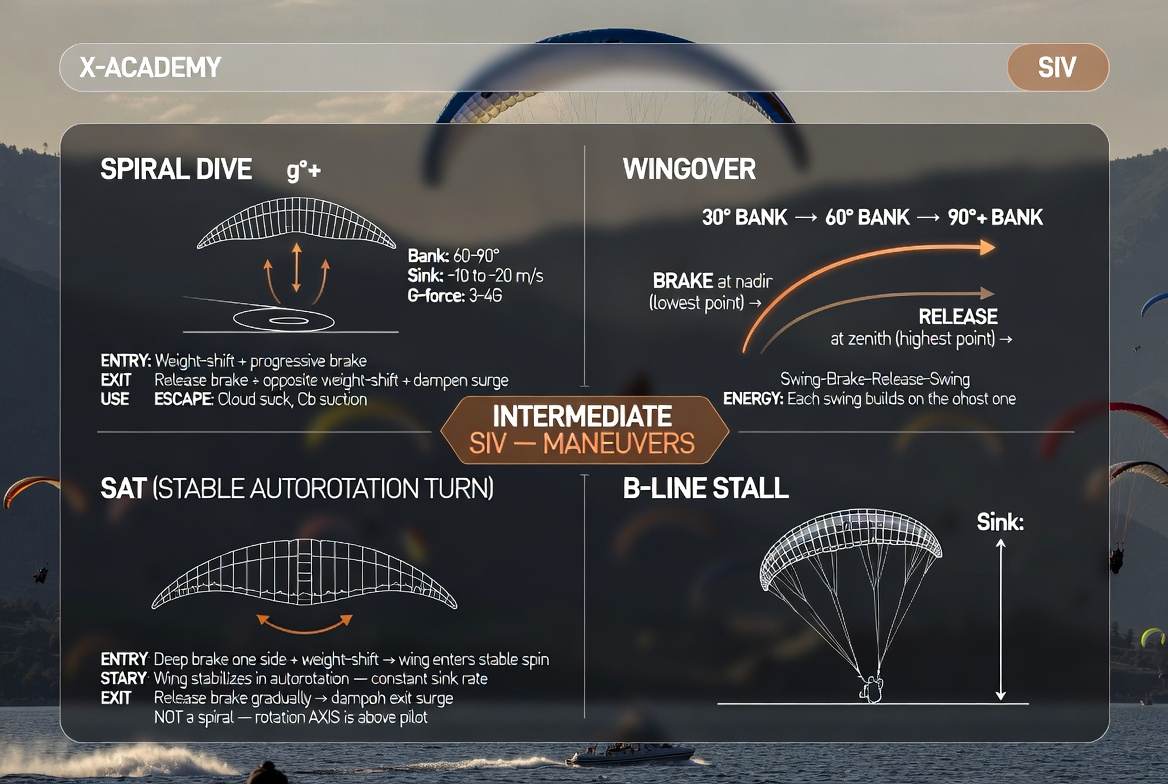
A. Spiral Dive
This is the most effective, though physically demanding, maneuver for rapid altitude loss in paragliding.
Execution Technique: The pilot initiates a weight shift to one side while gradually adding brake pressure. The wing begins to rotate, transitioning within seconds into a "nose-down" position.
Significance: When caught in "cloud suck" or needing an emergency landing due to deteriorating weather, the spiral is the only way to achieve a vertical descent rate of 15–20 m/s.
Critical Detail (The Exit): The most dangerous moment is a sharp exit from the spiral. If the brake is released too quickly, the wing converts its accumulated energy into a violent forward surge, which can cause a massive collapse. You learn the technique of dissipating energy gradually.
B. B-Stall
A maneuver that temporarily transforms the wing into a "vertical parachute."
Execution Technique: The pilot symmetrically pulls down the B-risers (the second row from the leading edge). The wing's profile "breaks" in the middle, the airflow detaches, and the wing enters a stable descent mode.
Significance: Unlike the spiral, there is no G-force or dizziness during a B-stall. It is a stable method of losing altitude (6–8 m/s).
Critical Detail: The release must be fast and crisp. If you release the risers slowly, the wing may remain in a parachutal stall. Additionally, hand symmetry is vital to avoid an unwanted wing spin.
C. Wingover
The foundation of "high-performance" piloting, requiring perfect coordination.
Execution Technique: The pilot performs rhythmic movements—combining weight shift and brake input. Each subsequent "swing" is higher than the previous one.
Significance: The wingover is the ultimate exercise for perfecting timing. It teaches you how to use the wing’s inertia to your advantage.
Critical Detail: Control of the "outside" wing. When the wing is at its peak point, the upper (outside) side loses pressure. The pilot must apply a slight brake to the outside to prevent the wingtip from collapsing. This is the peak of active piloting.
D. Advanced Asymmetric Collapses (On Speed Bar)
This is the most accurate simulation of a real-life threat.
Execution Technique: The pilot first pushes the speed bar to 50% or 100%, which increases the wing's speed and decreases its stability, then manually induces an asymmetric collapse.
Significance: A collapse at high speed is much more aggressive. The wing tends to enter a rotation (spiral) far more rapidly.
Critical Detail: Immediate release of the speed bar. Upon collapse, the very first reaction must be to step off the speed bar to allow the wing to return to its maximum stability profile, and only then begin course correction.
Summary: What do these maneuvers give you?
If Introductory SIV teaches you how to survive, Intermediate SIV teaches you how to dominate. You no longer fear the wing's energy; on the contrary—you know how to harness that energy for emergency descents or to maintain rock-solid stability in harsh thermals.