On this page
The Intermediate SIV Daily Training Plan is more than just a flight schedule; it is a logically structured progression designed to habituate the pilot to increasing dynamics and physical loads. Each day serves a specific psycho-physical transformation—moving from passive reaction to active mastery.
Here is the comprehensive, in-depth plan for the Intermediate SIV course:
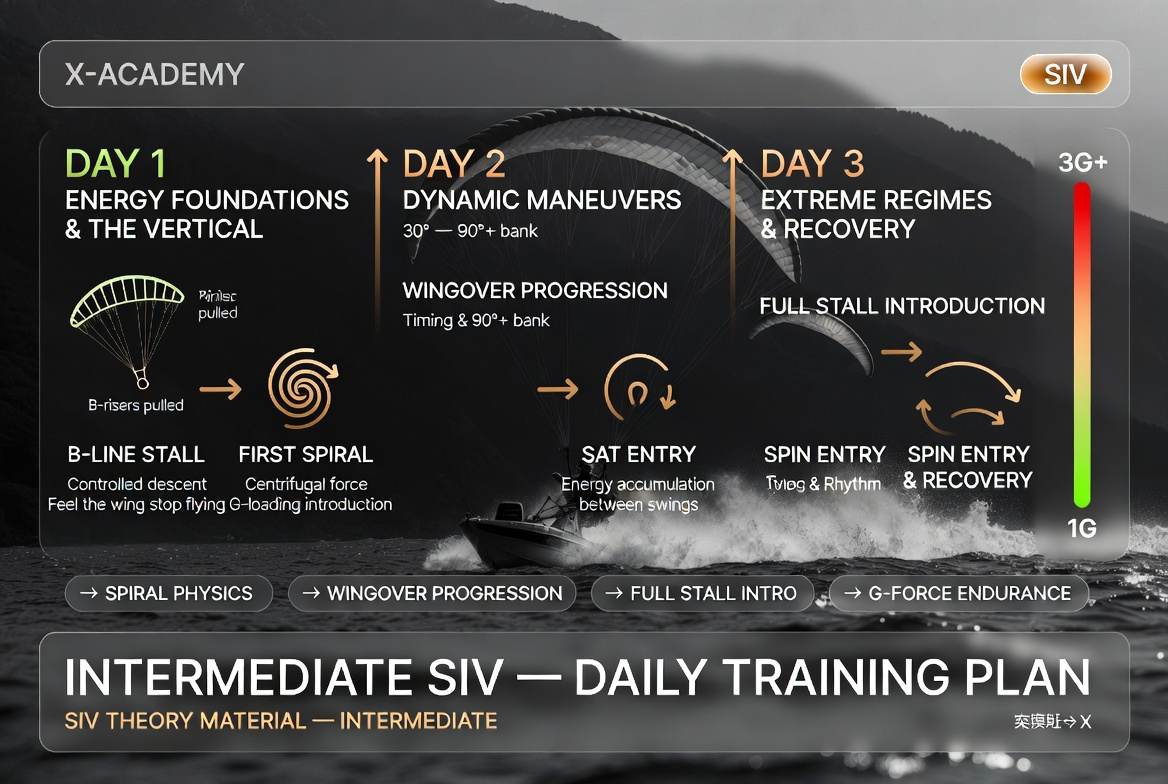
Day 1: Energy Foundations and the "Vertical"
The objective of the first day is for the pilot to feel the wing's inertia and learn how to lose altitude rapidly in a stable, controlled manner.
Theory: Spiral Physics and G-Loading. A detailed look at centrifugal force. The pilot must understand how blood circulation changes under high G-forces and learn the "Anti-G straining" technique (muscle tension and breathing control) to prevent grey-outs or loss of consciousness (G-LOC).
Flight 1 (Pitch & Roll Deepening): Emphasis is placed on the pendular movements of the wing. The pilot learns to "catch" the wing at its peak points. "Big Ears" with the speed bar serves as a preparatory stage to manage the wing under reduced stability.
Flight 2 (Introductory Spirals): Executed at shallow angles, the primary goal here is not maximum speed, but the exit technique. You learn to dissipate energy gradually so the wing does not produce a violent forward surge upon exiting.
Flight 3 (B-Stall Repetitions): This maneuver develops symmetrical hand work. The pilot habituates to the sensation of the wing stopping horizontal flight and entering a vertical descent, requiring composure and correct timing for profile recovery.
Day 2: Dynamic Management and Timing
On the second day, the pilot moves into the "Active Phase," where maneuvers become faster and the amplitude increases.
Theory: Wingover Timing and Rotation Management. We analyze the specific points for weight-shifting and brake input. This is the most "mathematical" part of the course, where fractions of a second determine the cleanliness of the maneuver.
Flight 1 (First Wingovers): The pilot learns to catch the rhythm. Starting from low amplitude, energy is built up gradually. The instructor's role over the radio is critical to prevent exceeding critical angles before timing is perfected.
Flight 2 (Deep Spiral Dive): Transitioning to actual vertical speeds (15+ m/s). The pilot learns to fix their gaze on the horizon to maintain orientation and a cool head despite high noise and pressure.
Flight 3 (Asymmetric Collapses on Speed Bar): The climax of the day. Collapses at high speed are far more aggressive. The pilot trains the immediate, instinctive release of the speed bar—a primary survival skill in real-world flying.
Day 3: Complex Maneuvers and Examination
The third day is dedicated to integrating all learned skills and verifying the pilot's independence.
Theory: Incident Combinations. Handling complex scenarios: what to do if the wing collapses during a spiral or if a "Twist" (riser twist) occurs during a wingover. You learn to prioritize actions in a crisis.
Flight 1 (High Wingovers): The peak of dynamic piloting. The pilot swings the wing above the horizon (and sometimes below the pilot's level), requiring perfect outside brake tension to prevent a collapse.
Flight 2 (Rapid Exit Simulation): Simulating an emergency where the pilot must exit a spiral quickly. The wing will attempt a violent forward surge, and the pilot must dampen this energy instantly and symmetrically.
Flight 3 (Elective Repetitions and Final Exam): The pilot performs maneuvers with minimal guidance. This verifies that theoretical knowledge has successfully transitioned into muscle memory.
Why is this Plan Significant?
Safety Filter: The progressive approach prevents psychological trauma. A pilot does not move to a complex trick until they prove mastery over the previous step.
Automation: Three days of intensive training build the automatic reactions necessary for survival during a real-life emergency.
Professional Standard: Successfully completing this plan is a guarantee that the pilot is prepared for Thermal Flying (P3) and Tandem Piloting (T1/T2) certifications.