On this page
This is one of the most critical aspects within an Intermediate SIV course. While a pilot learns how to prevent wing collapses at the introductory stage, the main challenge at the intermediate level becomes preventing "negative regimes" (Spin/Stall) during dynamic maneuvers.
Here is why sensing the "Stall Point" is decisive and how it manifests in practice:
1. What is the "Stall Point" in Dynamics?
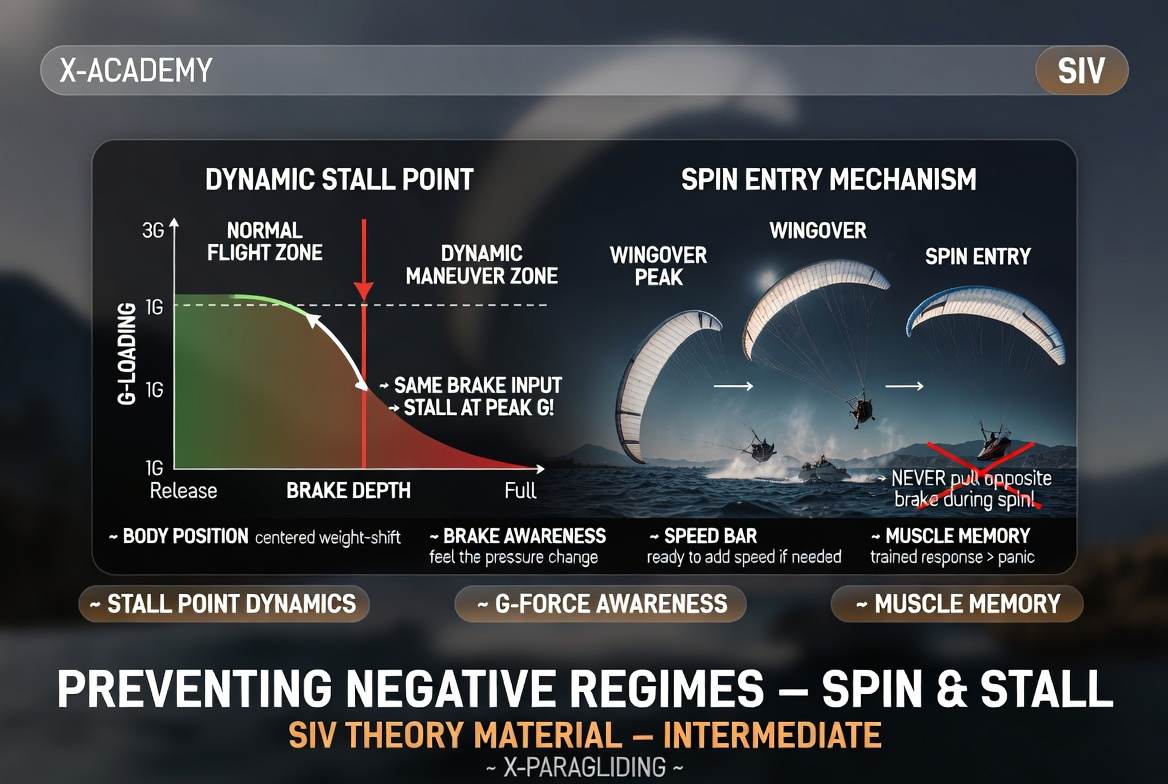
In normal flight, the stall point is a specific brake depth where airflow detaches. However, during dynamic maneuvers (e.g., wingovers), this point is dynamic and shifting:
Energy & Loading: When the wing builds up energy and reaches its peak point, the load (G-force) on the wing decreases significantly.
Sensitivity: Under low loading, the wing stalls much more easily than in normal flight. A pilot who lacks this "feel" might instinctively over-brake the wing exactly when it has the least airspeed.
2. Wingover and "Negative Spin"
The wingover is a maneuver where knowledge of the stall point is vital for survival:
Inner Brake: If the pilot pulls the inner brake too deeply at the peak of a wingover (when the wing is above the horizon) to initiate rotation, the inside of the wing will instantly stop and enter a negative spin.
Result: The wing begins to rotate rapidly around its vertical axis, leading to riser twists and complete loss of control.
3. Sensing "Heavy" vs. "Light" Brakes
An intermediate pilot must learn to "read" the internal pressure of the wing through the brakes:
Informational Braking: Even with slight pressure on the brakes, the pilot feels resistance. If this resistance vanishes ("the brake goes soft/empty"), it means the wing is on the verge of a stall.
Reaction: At this moment, pulling the brake further is fatal. Instead, the pilot must move their "Hands Up" to allow the airflow to reattach.
4. Why is this Essential for P3 and T1/T2 Pilots?
Tandem Piloting: Tandem wings are heavier, and their stall points differ from solo wings. A pilot who doesn't feel this limit risks the passenger's safety during any sharp maneuver.
Thermal Flying: When exiting a strong thermal "bubble," the wing often experiences a surge followed by a loss of airspeed. Sensing the stall point helps the pilot avoid over-braking the wing during such turbulence.
Summary: The Pilot's "Third Eye"
Sensing the stall point is the pilot's insurance policy. During Intermediate SIV, this skill allows you to:
Perform high and aggressive wingovers without the risk of collapse or spin.
Manage the wing without encountering "Twists" (riser crossovers).
Be confident that in any dynamic maneuver, you are controlling the wing—not the other way around.