On this page
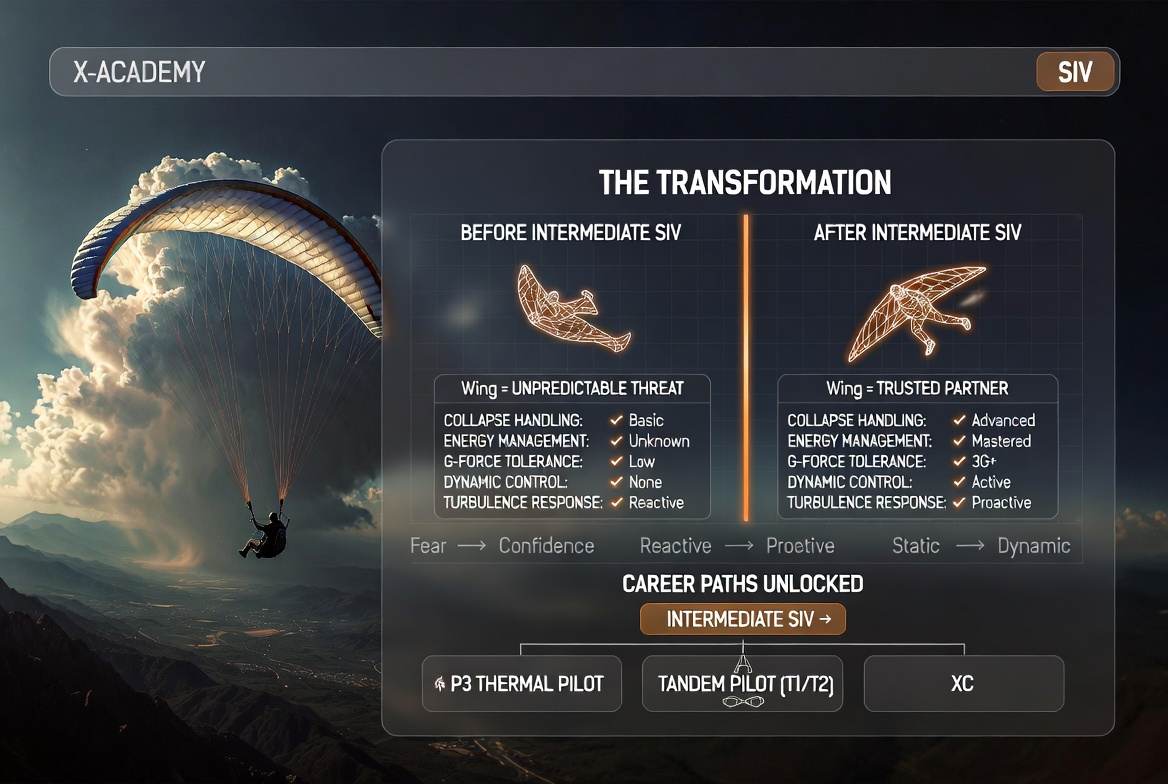
Intermediate SIV is not just about "more tricks"—it is the transition from static safety to dynamic management. While the introductory level focuses on preventing collapses, here you learn how to handle the massive kinetic energy a wing accumulates during turbulence or maneuvers.
For a professional pilot, this stage is a critical and mandatory milestone. Here is an in-depth analysis of why:
1. Energy Management: "Taming the Wing"
In turbulent air or thermals, a wing is rarely in a neutral state; it is constantly accumulating kinetic energy.
Inertia Control: At the intermediate level, the pilot learns to manage the wing's pitch and roll not just at the onset, but when the glider is already moving with high velocity.
Timing: This is the core keyword of the course. You learn that a brake input made just 0.2 seconds too early or too late can completely change the outcome of a maneuver or a recovery.
2. Critical Importance for P3 and T1/T2 Pilots
On the path to professional licensing (Tandem, Instructor), this course is the turning point:
Tandem Specifics (T1/T2): A tandem wing has significantly more inertia than a solo wing. If a pilot does not know how to dampen dynamic energy, any small oscillation can escalate into a large amplitude, which is dangerous and uncomfortable for the passenger.
Thermal Flying (P3): In strong thermals, the wing often experiences asymmetric loading. Intermediate SIV teaches you how to use this energy to gain altitude rather than losing control to it.
3. G-Force and Psycho-Physical Endurance
This is where a pilot first encounters serious physical loads.
The Spiral Effect: During a deep spiral, a pilot is subjected to $3-4G$ loads. The course teaches you how to maintain mental clarity, vision, and radio communication under these conditions.
Spatial Orientation: When the wing is descending at $15-20$ m/s and rotating rapidly, the brain must learn to maintain a sense of the horizon. This skill is a lifesaver during real-life "cloud suck" scenarios.
4. A New Level of Safety: Active Prevention
At this stage, the pilot becomes "proactive" rather than reactive:
Wingovers: These are not just for show. The wingover is the ultimate exercise for feeling internal wing pressure. You learn how to keep the wing pressurized and solid even when it swings below you.
Speed Management: Intermediate SIV teaches you that speed (using the accelerator/speed bar) is your friend, not your enemy, provided you know how to use it correctly during collapses.
Why is this Structured Approach Significant?
Professional Ethics: A pilot flying a passenger is obligated to master energy management techniques to remain the master of the situation in any turbulent environment.
Equipment Longevity: Improper handling (harsh "stabs" on the brakes) damages the wing and the lines. Intermediate SIV teaches "smooth" and efficient piloting.
Self-Confidence: This course breaks the final barrier between a pilot and their capabilities. You stop "fearing" the wing and start collaborating with it.
Summary
Intermediate SIV is the bridge between an amateur pilot and a professional. Participating in thermal or tandem flights without it is an unjustifiable risk.