

On this page
At the P5 level, breaking Cross-Country (XC) records is no longer about luck—it is a precise science that integrates nature-reading, biology, and physics. When the goal is to fly 200, 300, or more kilometers, every single detail becomes decisive.
Here is the in-depth English translation of these complex XC planning and logistics topics:
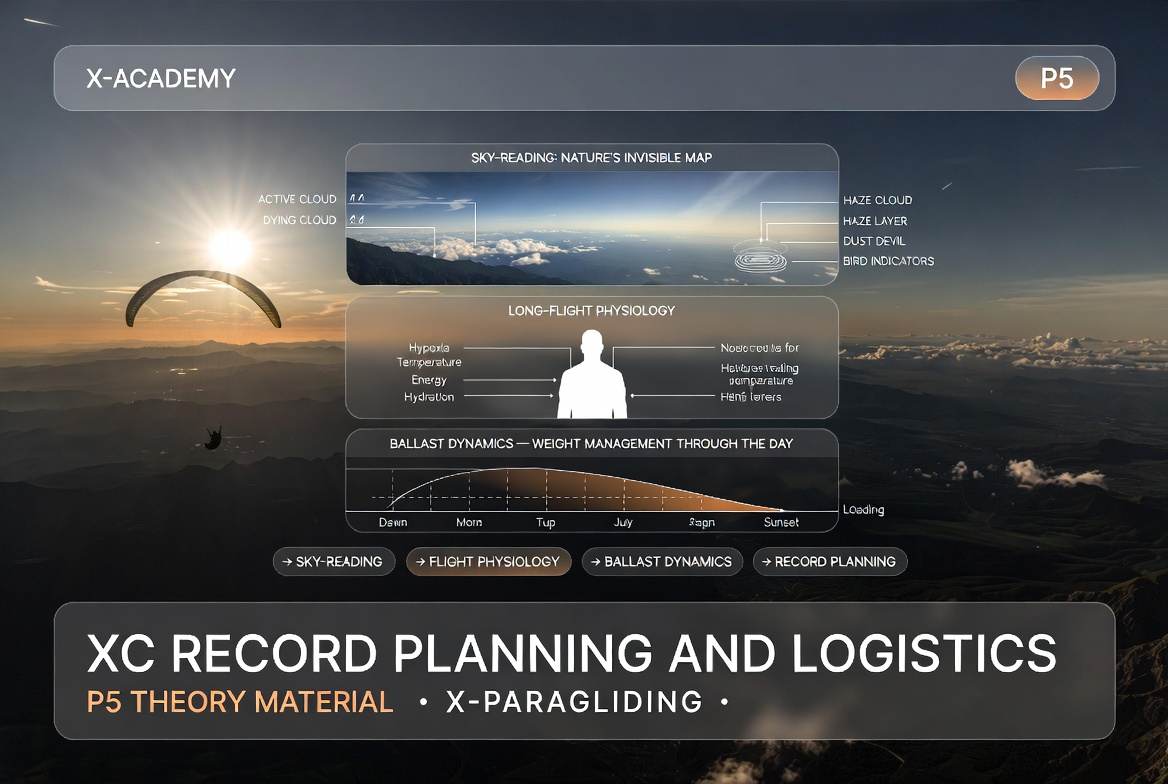
1. Sky-Reading: Interpreting Nature’s "Invisible" Language
A P5 pilot views the sky as a map. Where others see only a cloud, the expert sees the dynamic movement of air currents.
Micro-Signs on the Horizon:
Humidity and Haze: A slight rise in the layer of dust or humidity on the horizon indicates the altitude of the Inversion. If you see dust rising higher, it means thermals are "breaking through" this layer.
Bird Behavior: While eagles are great indicators, a P5 pilot also watches swallows—they often follow insects that are carried upward by thermals.
Dust Devils: On dry terrain, these swirling vortexes show you the exact core of a thermal before it even reaches cloud level.
Cloud Anatomy: A P5 pilot distinguishes a "working" cloud from a "dying" one. Hard, well-defined edges indicate an active upward flow, while frayed, "cotton-like" edges signal dissipation.
2. Physiology of Long-Endurance Flight
Flying for 8–10 hours at altitudes of $4,000\text{ meters}+$ is an extreme test for the human body. Physical exhaustion invariably leads to mental errors.
Hypoxia and Oxygen: Oxygen deprivation at high altitudes slows down decision-making. P5 pilots often use portable oxygen systems (Cannulas) during record attempts to maintain $100\%$ cognitive efficiency.
Nutrition and Hydration:
Hydration: Dehydration significantly increases the risk of hypoxia. It is essential to drink water in small, frequent doses (using a Camelbak) throughout the flight.
Energy: A drop in blood glucose leads to a loss of concentration. Slow-release energy sources like gels or nuts are recommended.
Temperature Management: Temperatures at altitude can drop to $-10\text{°C}$ or lower. Hypothermia immediately degrades a pilot's reaction time.
3. Ballast Dynamics (Ballast Management)
At the P5 level, ballast is not just "dead weight"—it is a tool for managing the tempo of the flight.
Variable Wing Loading:
Morning (Weak Conditions): The pilot starts with minimal ballast to stay aloft and "scratch" out of weak thermals.
Midday (Peak Conditions): As thermals strengthen ($+5\text{--}7\text{ m/s}$), the pilot uses prepared ballast ($5\text{--}10\text{ kg}$) to increase wing stability, Trim Speed, and glide efficiency in turbulent air.
Dumping Strategy: Toward the end of the flight, as conditions weaken, the pilot gradually dumps water ballast to make the wing "light" again, allowing it to stay up in the final, dying lift of the day.
Using Inertia: A heavy wing "pierces" through turbulent layers better and loses less energy when entering a strong thermal.
Why is this important?
An XC record is achieved not when you "get lucky," but when your physical state, wing loading, and knowledge of nature's signs are in perfect synchronization. A P5 pilot does not wait for the weather—they manage it through their expertise.