For a P5-level pilot, meteorology is no longer just about a "local forecast." It is the deep knowledge of atmospheric physics that allows you to fly in places others wouldn't even dare to imagine.
1. The Tropopause and Jet Streams
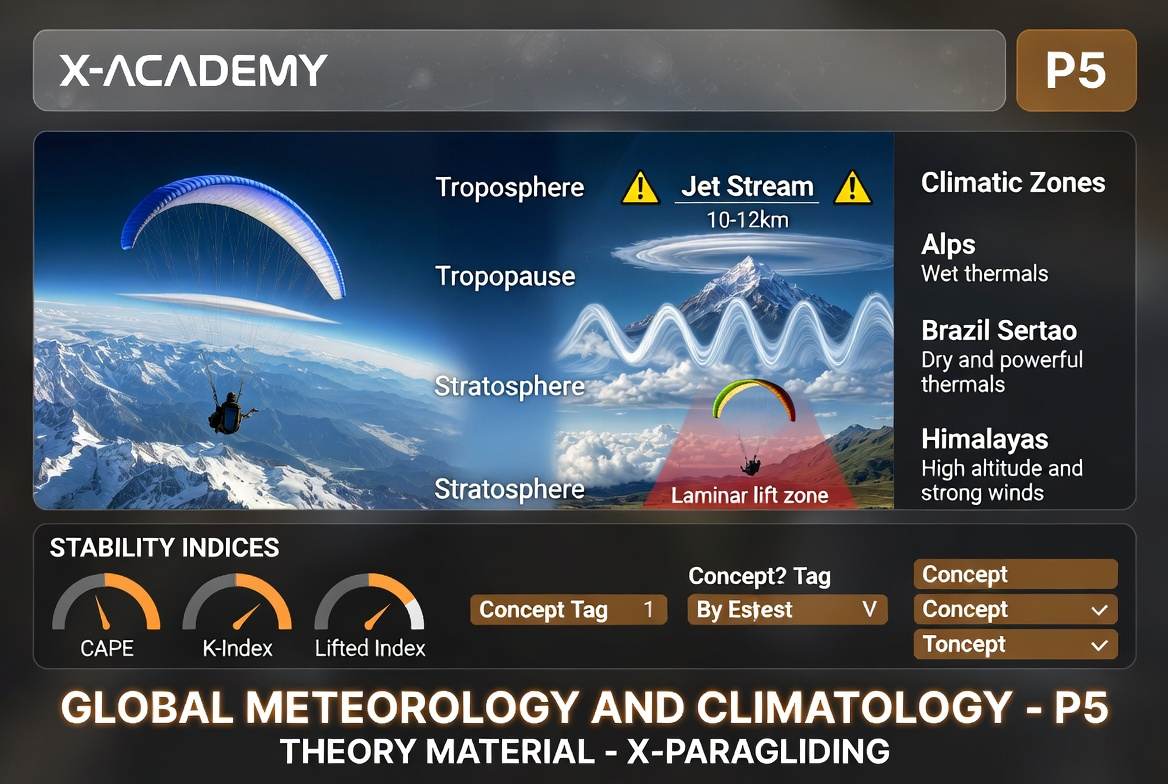
The Tropopause is the "ceiling" where weather formation ends. For a P5 pilot flying at extreme altitudes (Himalayas, Alps), understanding this zone is critical.
Jet Streams: These are narrow, powerful wind bands near the tropopause (9–15 km altitude). However, their influence often descends to flyable altitudes.
Impact on Flight: If a jet stream "dips" lower, it causes extreme turbulence and wind speeds that far exceed a paraglider's penetration capabilities. A P5 pilot analyzes high-altitude charts (300 hPa / 500 hPa) to ensure that winds in the upper layers are not catastrophically strong.
2. Lee Waves and Extreme Lift
The "Wave" is the Holy Grail of meteorology, allowing pilots to ascend to 8,000–10,000 meters.
Formation Conditions: Strong, stable winds striking a large ridge perpendicularly, where the wind speed increases with altitude.
Recognition Signs:
Lenticularis (Lenticular Clouds): Stationary clouds that look "sculpted." They indicate the peak of a wave.
Rotor Clouds: Chaotic clouds beneath the wave where severe turbulence occurs.
Technique: The pilot passes through the Rotor (which is extremely dangerous) and enters the "laminar" rising air, where the variometer shows a steady +5–10 m/s without any turbulence.
3. Climatic Zone Analysis
Thermals are not the same everywhere. A P5 pilot must adapt their flying style based on the region:
The Alps (Moist Thermals): Thermals are often narrow, strong, and capped by Cumulus clouds. The key is working the cloud base and maintaining "base" altitude.
Brazilian Sertão (Dry and Powerful): Thermals here are often "Blue" (no clouds). The air is very dry, and thermals are wide and aggressive. This requires maximum ballast and high speed.
The Himalayas (High-Altitude Dynamics): Due to lower air density, the wing flies faster, but maneuvers are sharper. Powerful Valley Winds, which change direction throughout the day, are added to the thermals here.
4. Atmospheric Stability Indices
At the P5 level, a pilot no longer looks only for "sunny weather." They study:
CAPE (Convective Available Potential Energy): The amount of energy that determines whether a thermal will be "calm" or evolve into a thunderstorm (Overdevelopment).
Inversion Layers: How an inversion "caps" thermals and at what specific altitude the climb will stop.