On this page
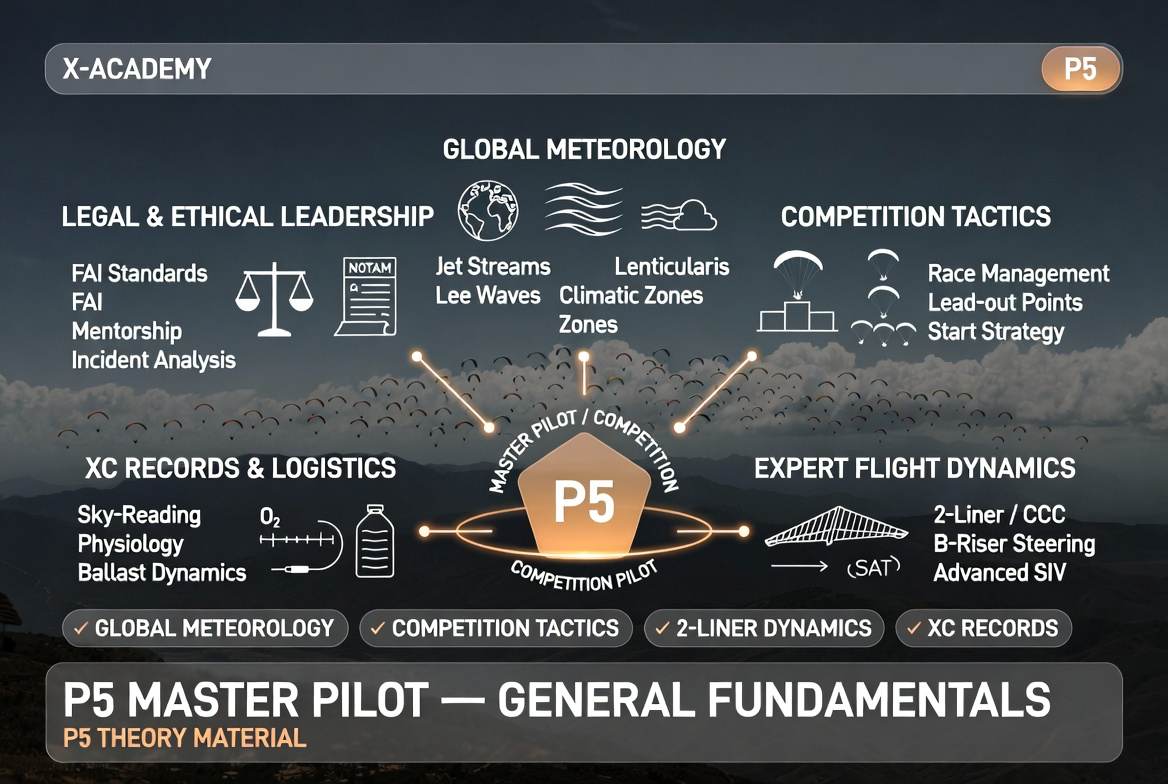
The P5 (Master Pilot / Competition Pilot) level is the pinnacle of paragliding, granting a pilot expert status. At this stage, the pilot is no longer just an enthusiast—they are an athlete, a candidate for instructorship, or a master of long-distance Cross-Country (XC) flying.
The P5 course focuses on competition strategy, ultra-long-distance flights, and psychological management in extremely demanding conditions.
Here is the English translation of the core theoretical modules for the P5 syllabus:
1. Global Meteorology and Climatology
A P5 pilot must understand atmospheric behavior on a macro scale.
Tropopause and Jet Streams: Understanding their influence when flying in high-altitude mountain ranges.
Lee Waves: How to identify and utilize wave lift to climb to altitudes of $8,000\text{m}+$.
Climatic Zone Analysis: How thermal characteristics change across different continents (e.g., the Alps vs. the Himalayas vs. the Brazilian Sertão).
2. Competition Tactics and Strategy
This module prepares the pilot for international tournaments (PWC, World Championships).
Race Management: Knowing when to fly with the Gaggle (group) and when it is strategically advantageous to choose an independent line.
Start & Goal Cylinder Strategy: Selecting the optimal timing and position during the race start.
Lead-out Points: Understanding the scoring system and how it dictates the pace of the flight.
Mental Toughness: Maintaining peak concentration during 5–7 hour high-stakes races.
3. Expert Flight Dynamics
P5 pilots typically fly EN-D (2-liner) or CCC class wings.
2-Liner Handling: Mastery of B-riser steering and pitch control while at maximum speed.
Collapse Management at High Speed: Recovering from collapses while using $100\%$ of the speed bar (accelerator).
Advanced SIV: Knowledge of acro elements (e.g., SAT, Helicopter) to achieve absolute wing control.
4. XC Record Planning and Logistics
Sky-Reading: Interpreting micro-visual cues (humidity, bird behavior, dust) to predict lift.
Physiology of Long-Endurance Flight: Nutrition, hydration, and the use of supplemental oxygen above $4,000\text{ meters}$.
Ballast Dynamics: Sophisticated use of water ballast to adjust wing loading throughout different phases of the flight.
5. Legal and Ethical Responsibility
Airspace Management: Thorough knowledge of complex NOTAMs and international FAI regulations.
Mentorship: Taking responsibility for the safety of junior pilots and organizing group expeditions.
Incident Investigation: The ability to analyze flight accidents to improve safety standards within the community.
6. Digital Analytics
Tracklog Analysis: Detailed post-flight analysis using SeeYou or similar software—identifying where time was lost and where thermals were strongest.
Waypoints & Tasks: Pre-programming complex routes and calculating the mathematically optimal path (Optimized Route).