

On this page
For a P5-level pilot, a competition is no longer just about "completing a route." It is a game of 3D chess where every second and every meter is calculated. In international tournaments like the PWC (Paragliding World Cup), victory is determined not just by raw speed, but by mathematical optimization and psychological resilience.
Here is the in-depth English analysis of these critical competition topics:
1. Race Management: The "Gaggle" and Independent Lines
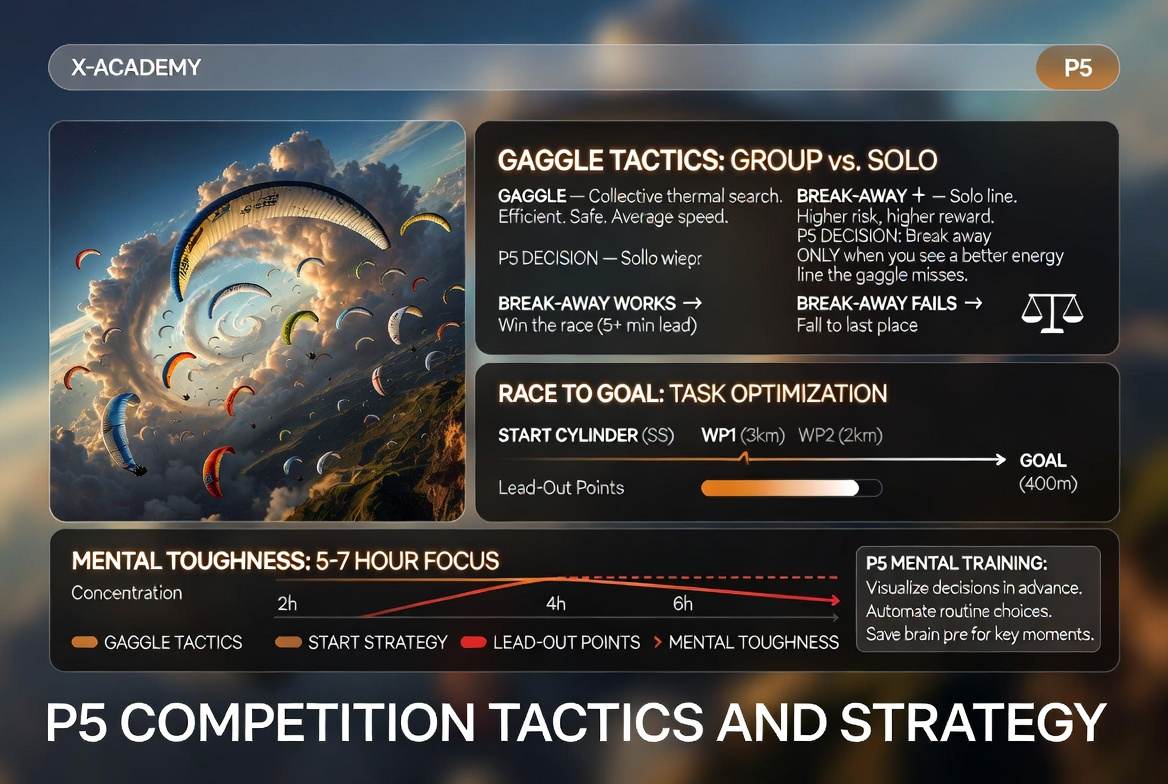
During a race, pilots form groups known as Gaggles. A P5 pilot must master these social and technical dynamics to serve their own strategic goals.
Collective Intelligence: Thirty pilots searching for a thermal together are far more efficient than one. The group "reveals" the exact core of the rising air. A P5 pilot uses the gaggle to conserve energy and maintain a high average speed.
The Break-away: Knowing when to leave the group is vital. If you spot a better cloud street or a more logical terrain transition that the group is overlooking, taking an independent line can be decisive. This is a high-risk, high-reward strategy: if it works, you win the race; if not, you sink to the bottom of the rankings.
2. Start & Goal Cylinder Strategy
The race begins long before the start line is actually crossed.
Start Tactics: A P5 pilot calculates their timing so that at the exact second of the "Start Open," they are already at maximum altitude and crossing the start cylinder at full speed. This requires precise glide calculations using digital instruments like XCTrack.
Final Glide: Approaching the finish, the brain must function like a computer. You must know your exact L/D (Lift-to-Drag) ratio to break away from the final thermal at the minimum altitude necessary to reach the goal at full speed (on the speed bar). Every extra second spent in a thermal is a point lost on the scoreboard.
3. Lead-out Points and Scoring Systems
Under the modern FAI GAP scoring system, being the first to cross the finish line does not always guarantee a win.
Lead-out Points: You are awarded points for being at the front of the pack and "pulling" the group. If two pilots reach the goal simultaneously, the one who spent more time in the lead position throughout the race will win.
Pacing: A P5 pilot often chooses to fly among the leaders to accumulate lead-out points rather than attempting a solo sprint. It is a constant balance between raw speed and statistical advantage.
4. Mental Toughness
At the P5 level, a race can last 5 to 7 hours, during which the pilot is under constant pressure.
Maintaining Concentration: In the face of exhaustion, tactical errors become easy to make. A P5 pilot practices "mental hygiene"—learning how to avoid euphoria after a successful maneuver and how not to lose hope when stuck at a low altitude.
Decision Speed: During a race, there is no time for second-guessing. Decisions (e.g., leaving a thermal to push forward) must be lightning-fast, based on a synthesis of intuition and digital data.