

On this page
At the P5 level, piloting moves beyond intuition and becomes a data-driven science. Digital analytics is the tool that allows you to "see" the air after the flight and plan the ideal trajectory before taking off. Mastery means finding the mistakes you didn't even notice while in the air.
Here is the in-depth English translation of the two most important directions in digital analytics:
1. Tracklog Analysis: Post-Operational "Dissection" of the Flight
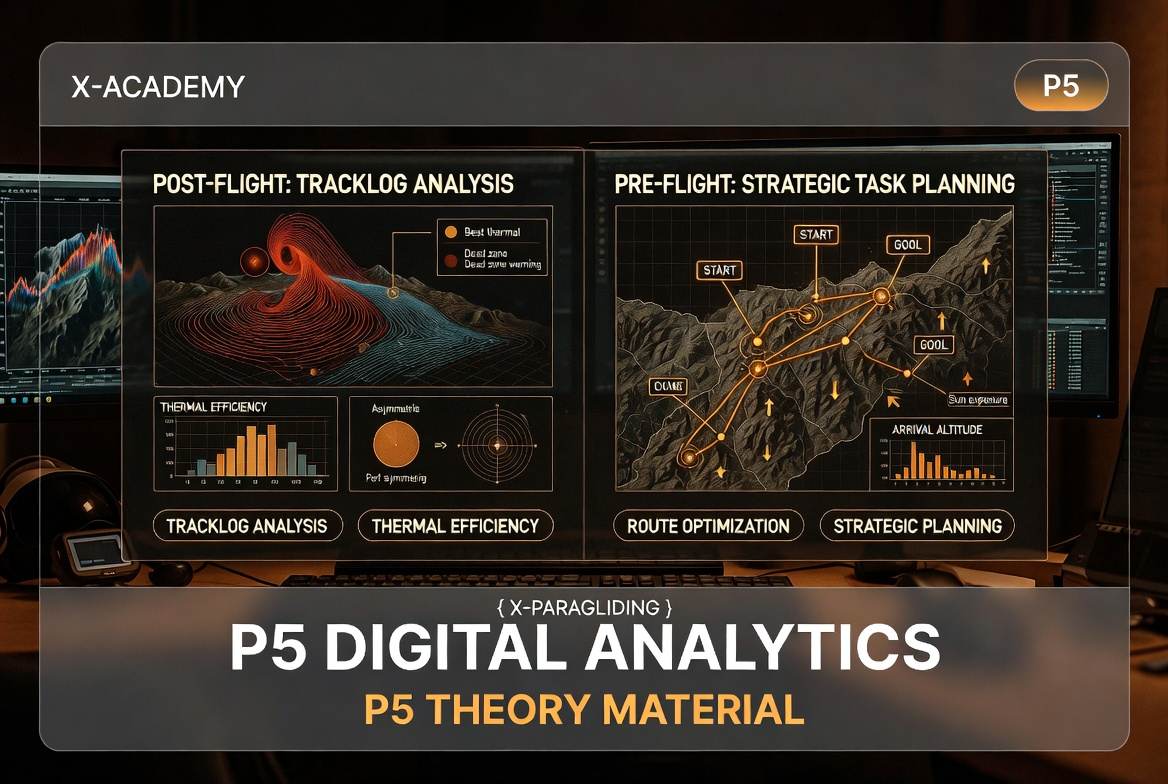
Analyzing tracklogs (using software like SeeYou, CloudBase.Way, or XC-Analytics) is the only way to achieve real progress. A P5 pilot doesn't just look at the kilometers flown; they analyze efficiency.
Thermal Efficiency:
The software calculates time spent in a thermal and measures your "Circle symmetry." If your spiral is not symmetrical, you are losing time and lift.
Climb Rate vs. Average: A P5 pilot compares their climb rate with data from other pilots on the same day. If others climbed faster, the analysis shows you exactly where the thermal core was that you missed.
Glide Optimization (Speed to Fly):
Analysis reveals how correctly you used the accelerator (speed bar) between thermals. Spending excessive time in "sinking air" indicates a flawed Speed to Fly strategy.
Time "Leakage" Points:
Software color-codes the trajectory (e.g., red for climbing, blue for sinking). A P5 pilot looks for "dead zones" where they performed unnecessary circles or chose an inefficient line, which reduced their average speed.
2. Waypoints & Tasks: Strategic Planning
Record-breaking XC flights or competitions do not begin at takeoff; they begin at the computer with the pre-programming of the route.
Waypoints:
A P5 pilot creates their own database, marking not just "Turnpoints," but also potential Trigger Points (areas where thermals almost always release) and safe landing fields.
Optimized Route Calculation:
Cylinders & Sectors: During a race, the pilot must calculate which specific point of a cylinder to "touch" so that the path to the next point is the shortest and most efficient regarding the terrain.
Arrival Altitude: In flight computers (XCTrack, LK8000), the pilot enters specific data (wing polar, wind) so the device can accurately predict the altitude at which they will arrive at the next point.
Task Fulfillment:
When planning a complex route, solar movement (aspect/exposure) is taken into account—knowing which slope will "work" at which hour. A P5 pilot plans "time windows" for each section of the flight.
Why is this important?
Digital analytics frees the pilot from "guessing." Seeing your own mistakes in a program like SeeYou is a painful but necessary step—it is the fastest way to reach true mastery. A P5 pilot who masters these tools is always one step ahead of those who fly by "feel" alone.
Summary
A P5 Pilot is an individual for whom flying is no longer just a hobby, but a profound science and a form of sporting art. At this level, mastery is defined by the seamless integration of atmospheric physics, advanced technical skills, and psychological resilience.