On this page
At the P5 level, the pilot and the wing function as a single organism. EN-D and CCC (Competition Class) wings are unforgiving of mistakes, but in the right hands, they offer incredible performance. At this stage, flight dynamics evolve into the highest level of "active piloting."
Here is the in-depth English analysis of these expert-level flight dynamics:
1. 2-Liner Handling and B-Riser Steering
The emergence of 2-liner wings has revolutionized paragliding. For a P5 pilot, steering with B-risers is as natural as using the brake toggles.
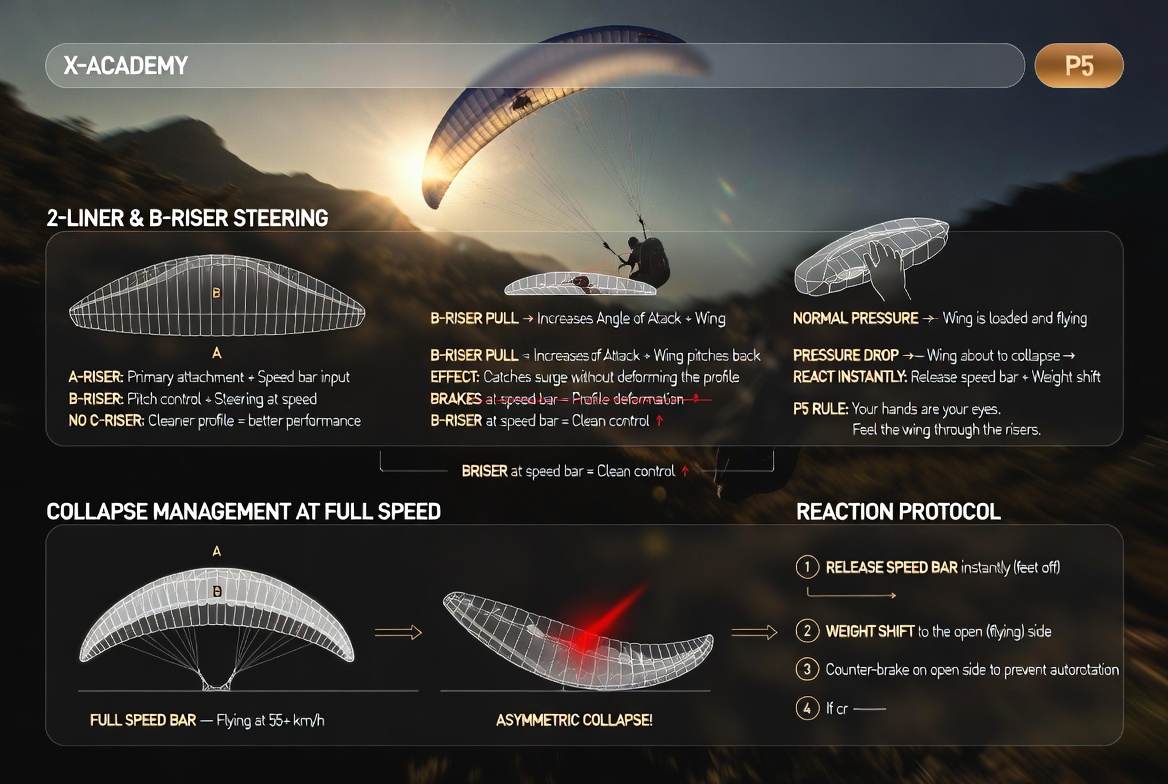
The Philosophy of Rear-Riser Steering: When flying on the speed bar (accelerator), using the brakes is prohibited as it deforms the wing profile and increases the risk of a collapse. A P5 pilot uses the B-risers to make instantaneous corrections to the wing's Angle of Attack.
Pitch Control: When the wing surges forward in turbulent air, the pilot applies a slight pull on the B-risers. This allows the pilot to maintain maximum speed while keeping full control of the wing without compromising the profile.
Pressure Feedback: Through the B-risers, the pilot feels the internal pressure of the wing. A drop in pressure on the riser is a signal that the wing is about to collapse—the reaction must be immediate.
2. Collapse Management at High Speed
A collapse on an EN-D or CCC wing while at 100% acceleration is one of the most aggressive events in paragliding. A P5 pilot must have automated reflexes.
Instant Accelerator Release: At the very first millisecond of a collapse, the pilot must release the speed bar. This increases the angle of attack and assists the wing in its recovery.
Directional Control: High Aspect Ratio wings are prone to immediate rotation during a collapse. The P5 pilot’s primary task is to prevent "autorotation." This is achieved through aggressive weight shifting and measured braking on the open side.
Cravat Prevention: High-performance wings are susceptible to "cravats" (knots). The pilot must be proficient in the "stabilo line" pull technique or, if necessary, use a Backstall to clear the wing.
3. Advanced SIV and Aerobatic Elements
For a P5 pilot, acrobatics are not just for show; they are tools for achieving 100% wing control.
Stall Mastery: The Full Stall and Backfly are the foundation. A P5 pilot must know how to safely exit a "Deep Stall" without any massive surges.
SAT (Semi-Acrobatic Trick): This maneuver teaches the pilot to manage centrifugal forces and structural stability under high loading.
Helicopter: One of the most difficult maneuvers, where the wing rotates around a vertical axis. Mastering it gives the pilot the fine motor skills critical for taming a wing in strong thermals.
Spin Control: A P5 pilot must know exactly where the limit of a negative spin lies to rotate the wing as efficiently as possible in narrow thermal cores.
Why is this important?
Flying at the P5 level is "walking on the edge." A pilot who masters aerobatic elements and B-riser steering feels far safer on an EN-D wing than an inexperienced pilot does on an EN-B. This skill set allows you to focus on the race rather than survival.