On this page
At the P5 level, a pilot is no longer just an individual player—they become a leader and an expert within the aviation community. At this stage, legal and ethical responsibility is as vital as flight technique. Mastery means not only managing risks for oneself but also setting safety standards for others.
Here is the in-depth English translation of these fundamental legal and ethical principles:
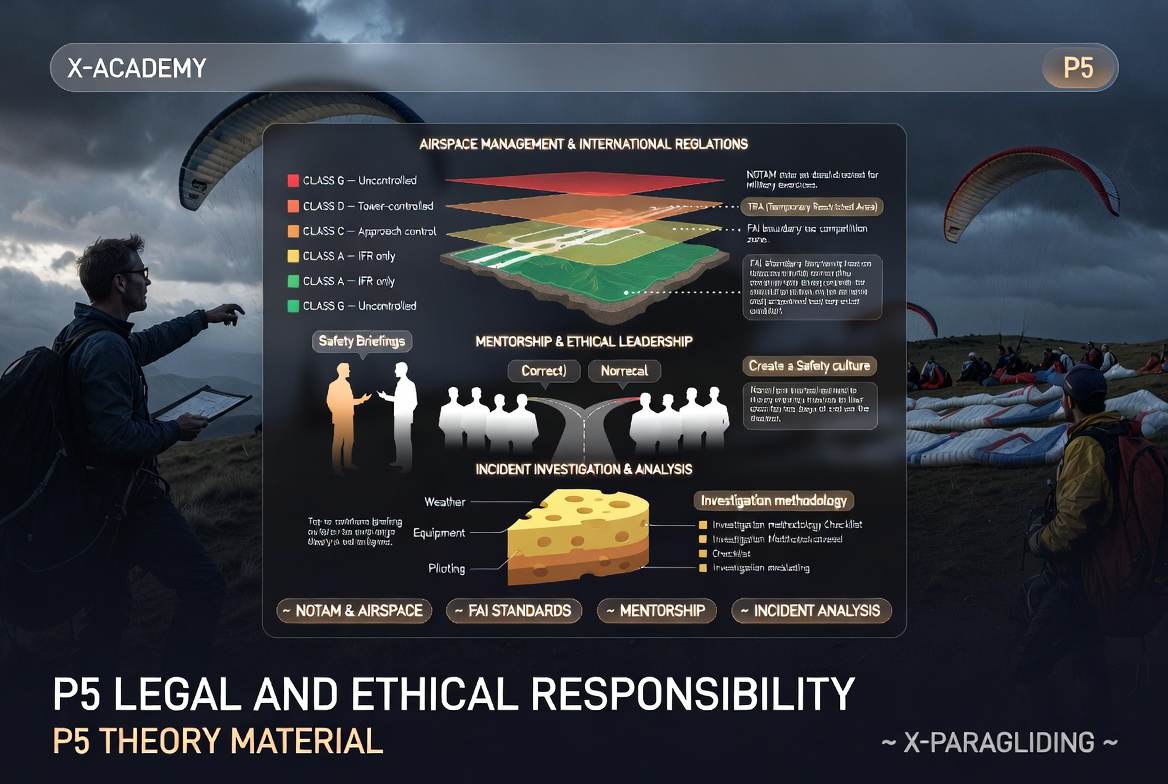
1. Airspace Management and International Regulations
For a P5 pilot, airspace is a complex and dynamic system where a mistake can lead not only to fines but also to significant hazards for commercial aviation.
NOTAM (Notice to Airmen) Analysis: A P5 pilot must know how to read and interpret complex aviation notices. This includes Temporary Reserved Areas (TRA), military exercises, or special air corridors. They do not rely solely on smartphone apps; they consult official aeronautical information sources.
FAI (Fédération Aéronautique Internationale) Standards: Thorough knowledge of international regulations is essential for validating XC records and participating in sanctioned competitions. This involves understanding what constitutes a "clean" flight and the ethical norms of sporting conduct.
Conflict Zone Prevention: The pilot must understand the specifics of different airspace classes (A, C, D, G) and constantly monitor their position via GPS transponders or flight instruments to prevent unauthorized incursions into civil aviation routes.
2. Mentorship: Leadership and Group Flight Organization
P5 status grants a pilot the unofficial (or official) role of a mentor. Their ethical duty is to transfer knowledge and ensure the safety of the community.
Creating a Safety Culture: A mentor demonstrates by example that "heroism" is not achieved through unnecessary risk. They help beginners evaluate the weather correctly and intervene when conditions exceed a pilot's specific category.
Managing Group Expeditions: When organizing XC expeditions, the P5 pilot is responsible for logistics, radio communication, and the "Safety Briefing." They assign roles within the group and ensure that no pilot is left alone in a critical situation.
Ethical Decision-Making: A mentor is obligated to prioritize the safety of others over their own personal records. If a group member is in a difficult situation, the P5 pilot abandons their own route to assist or coordinate help.
3. Incident Investigation and Analytics
Mastery involves learning from the mistakes of others and systematizing that knowledge to prevent future accidents.
Objective Analysis: Following an incident, a P5 pilot does not look for someone to "blame," but rather seeks the "cause." They analyze tracklogs, weather charts, and witness statements to reconstruct the exact chain of events.
Identifying the Human Factor: Most incidents are caused not by technical failure, but by poor decision-making. A P5 pilot studies the psychological factors (ego, group pressure, fatigue) that led to the incident.
Safety Reporting: Sharing the results of the analysis with the community (while maintaining confidentiality). This is an ethical responsibility—turning a bitter experience into educational material, which ultimately reduces the number of accidents in the paragliding industry.