On this page
The theoretical course on Meteorology and Dynamic Flight (Ridge Soaring) is fundamental for any pilot. It is the art of using the terrain and the wind to stay airborne for extended periods.
Here is the professional English translation of your syllabus:
1. Meteorology and Dynamic Lift
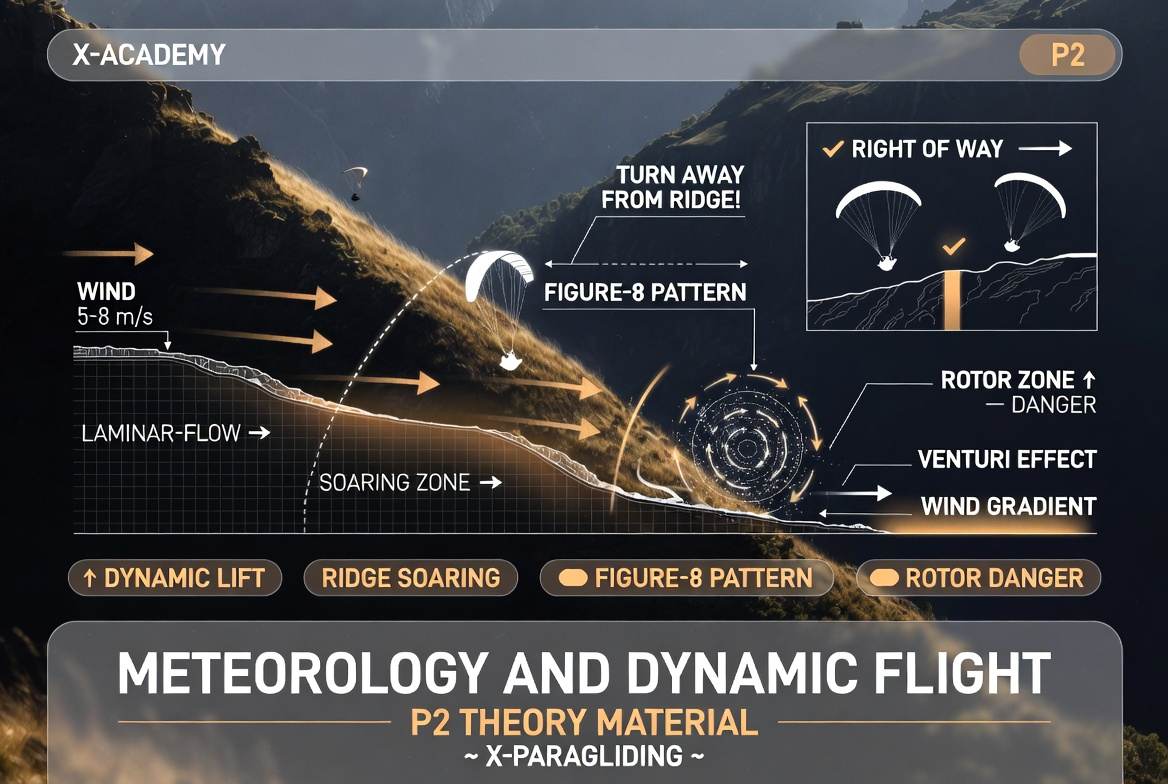
Dynamic Lift is created when a mass of air hits an obstacle (a ridge) and is forced upward.
Wind Angle: Ideally, the wind should be perpendicular to the ridge. If the angle exceeds $45^\circ$, the lifting force decreases sharply.
Wind Speed: Minimum speed depends on the slope's incline (usually 4–5 m/s). The maximum speed should not exceed your wing's trim speed.
Laminar Flow: Smooth, steady wind that is ideal for ridge soaring.
2. Executing Dynamic Flight (Technique)
When soaring a ridge, the pilot moves within the designated "Soaring Zone":
Trajectory: Fly parallel to the ridge. Use "Figure-8" maneuvers to maintain position.
Turning Rule: Never turn toward the ridge! Turns must always be made away from the slope (into the wind/valley) to avoid a collision.
Right of Way: If two pilots meet head-on, the pilot with the ridge on their right side has the right of way. The other pilot must yield by moving further to the right.
3. Analysis of Potential Risks
Dynamic flights carry specific environmental hazards:
Rotor: A turbulent zone on the downwind side (Lee Side) of the ridge. Entering this zone usually leads to immediate wing collapse.
Venturi Effect: An increase in wind speed at narrow passes, saddles, or the very crest of the ridge. This creates a risk of Blowback (being pushed behind the ridge).
Wind Gradient: A decrease in wind speed near the ground, which can be dangerous during the final landing phase.
4. Adhering to Safety Standards
Safe Margin: Always maintain a safe distance from the slope. This provides a "buffer" for maneuvering if the wind suddenly drops.
Speed Bar (Accelerator): Always have it properly connected and ready. If the wind increases and you lose forward progress, use the speed bar immediately.
Exit Strategy: If you notice the lift weakening, start moving toward the Landing Zone (LZ) well in advance.
5. International Terminology for Students
Ridge Soaring: Flying using the lift generated by a ridge.
Windward Side: The side facing the wind (the safe, lifting side).
Lee Side: The side sheltered from the wind (the dangerous, rotor side).
Compression: The acceleration of wind as it passes over the top of the ridge.
Crabbing: Flying at an angle to the wind to maintain a straight track parallel to the ridge without drifting into the slope.