On this page
Introduction
Aerodynamics is the physics of how air moves around objects - and for a paraglider, understanding it is like unlocking the secret to flying. Think of your wing as a conversation between you and the air. When you understand what the air wants to do, you can work with it instead of fighting against it. This guide uses simple ideas and real-world comparisons to help you grasp these concepts without needing a physics degree.
1. The Wing: Your Flying Machine
Your wing is not just fabric and lines - it's the bridge between you and the sky. Imagine your wing like a surfboard, but instead of riding on water, it surfs on air. When you launch, you're asking the air to push you up. This happens because of how the wing shape works with the moving air around it. The curved top and flatter bottom create invisible forces that lift you higher.
Here's the key idea: air doesn't like to change direction, but your wing forces it to. This creates an invisible push that holds you in the sky. Why does your wing push you to stay up? Think of it this way: fast-moving air around a curved surface creates a pressure difference. The faster the air moves, the lower the pressure becomes. This is why your wing's shape matters - it makes air rush faster over the top, creating lift underneath.
2. Air Pressure: Why Wings Work
Remember the seesaw on a playground? Aerodynamics works similarly. Your wing is a seesaw, and the air is the game. Now, what makes the seesaw balance? Pressure difference underneath.
Air moving over the curved top of your wing moves faster than air moving under the flat bottom. When air moves faster, it creates lower pressure (this is called Bernoulli's Principle). Slower-moving air underneath pushes harder than the fast-moving air above. Think of it like this: where air rushes fast, it doesn't push as hard. Where air moves slowly, it pushes more. Your wing uses this difference to stay aloft. So air pressure pushes you upward. This is the secret that keeps your wing flying.
3. Why Does Your Wing Move Forward? (Understanding Drag)
When you launch, you immediately feel it: a force pulling you down and backward. Why? Because your wing creates drag - resistance from the air. Think of drag as friction in the sky.
- Your wing pushes air aside as you move. This air pushes back on your wing - that's drag. The faster you go, the more drag increases (actually, it grows with the square of speed). The shape of your wing, your body position, and even your harness design create drag. Less drag means you fly farther.
- Paragliding, unlike powered flight, relies on finding rising air (thermals and ridge lift) to stay up. Your wing's shape determines exactly how much drag you experience during every maneuver. This drag-to-lift ratio is what defines your glide ratio - the key to distance and endurance. The better your glide ratio, the farther you fly.
4. Brakes: Controlling Your Wing (Brakes)
Your paraglider's most important control tool is simple - brakes (called brake lines). Pulling the brakes lets you control how your wing flies through the air.
Imagine operating the wing's back edge: when you pull down on the brake lines attached to the rear of your wing, you increase drag and reduce lift on that section. This does two things: your wing slows down (which increases drag significantly) and becomes less stable. So brakes make you descend faster? Not exactly - brakes create drag, but a paraglider without speed becomes unstable (loses lift). Think of brakes as your precision tool. When used correctly (smooth pressure), you control your descent. When used hard (jerking), you risk stalling. Key takeaway: smooth brake input lets you land safely - jerking the brakes is dangerous!
5. Four Essential Aerodynamic Concepts for P1 Pilots
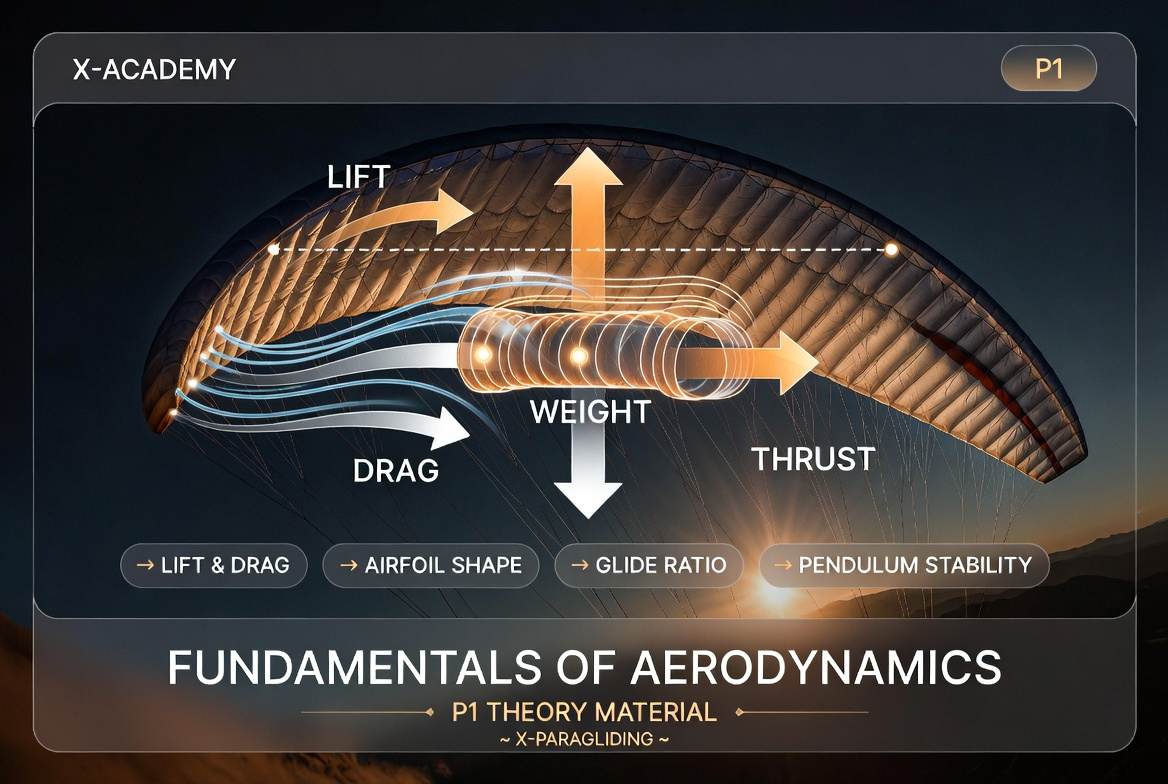
- Lift: The upward force created when air flows around your wing shape.
- Drag: Air resistance that opposes your forward motion through the sky.
- Wing Loading: Your weight divided by your wing's surface area - your personal wing's efficiency number.
- Glide Ratio: How many meters forward you travel for every meter you descend when not in rising air. A better glide ratio means flying farther.
6. Glide Ratio Explained Simply
Imagine you're in a plane losing an engine. How far can you glide before landing? That's glide ratio. Your EN-A paraglider has a glide ratio around 8:1. What does 8:1 mean? It means for every meter you descend, you glide forward 8 meters. Think of it this way: if you're 1 kilometer high, you can glide 8 kilometers forward (in still air with no rising air). Better gliders have ratios of 9:1 or higher - meaning they go even farther. This is why wing choice matters for distance flying.
Here's why glide ratio is crucial: a better glide ratio means you reach strong thermals more easily, even from lower altitudes. The better your glide, the more freedom you have to explore and climb higher. Understanding your wing's glide ratio teaches you: when your wing struggles to climb, fly efficiently to the next thermal (using brake restraint). Your wing's glide ratio determines your success in the air.
7. Stall: The One Mistake to Avoid (Safety Critical)
Beginner pilots learn gliding by understanding these control inputs step-by-step. A pilot stalls a wing using brake input. You must respect your limits. Key safety point: if your wing stalls, move the brakes back out immediately (using light restraint).. A stalled wing stops providing lift entirely - recovering requires perfect technique.
8. P1 Aerodynamics Checklist
- Your wing produces lift through shape and speed. The curved wing top creates lower pressure. Learn your wing's design characteristics.
- Drag is your constant opponent. Your body position matters. Straight legs, tucked harness - all reduce drag. The less jerky your movements, the better your efficiency.
- Control your descent carefully. Your wing has speed limits. Fly at book-recommended speed in normal conditions, slower in light air. Respect your wing's limits by checking the manual if uncertain.
- Trust your wing's design. Your wing was engineered and tested thoroughly. Follow weight limits and flight recommendations - your wing knows its job. Practice safe techniques and your glider will reward your respect by keeping you flying.
Summary
Aerodynamics is simply the relationship between you and the air. Your wing is not magic - it's physics you can understand using everyday analogies. Remember: the curved wing shape creates pressure differences that lift you up. Air resistance (drag) pulls you down and back. Your brakes let you control this dance with precision. As you gain experience, these basic concepts become instinct - your hands will just know what the wing needs. Flying confidently means understanding your wing's aerodynamics (the simple version). Your wing is ready whenever you are - go fly safely!