On this page
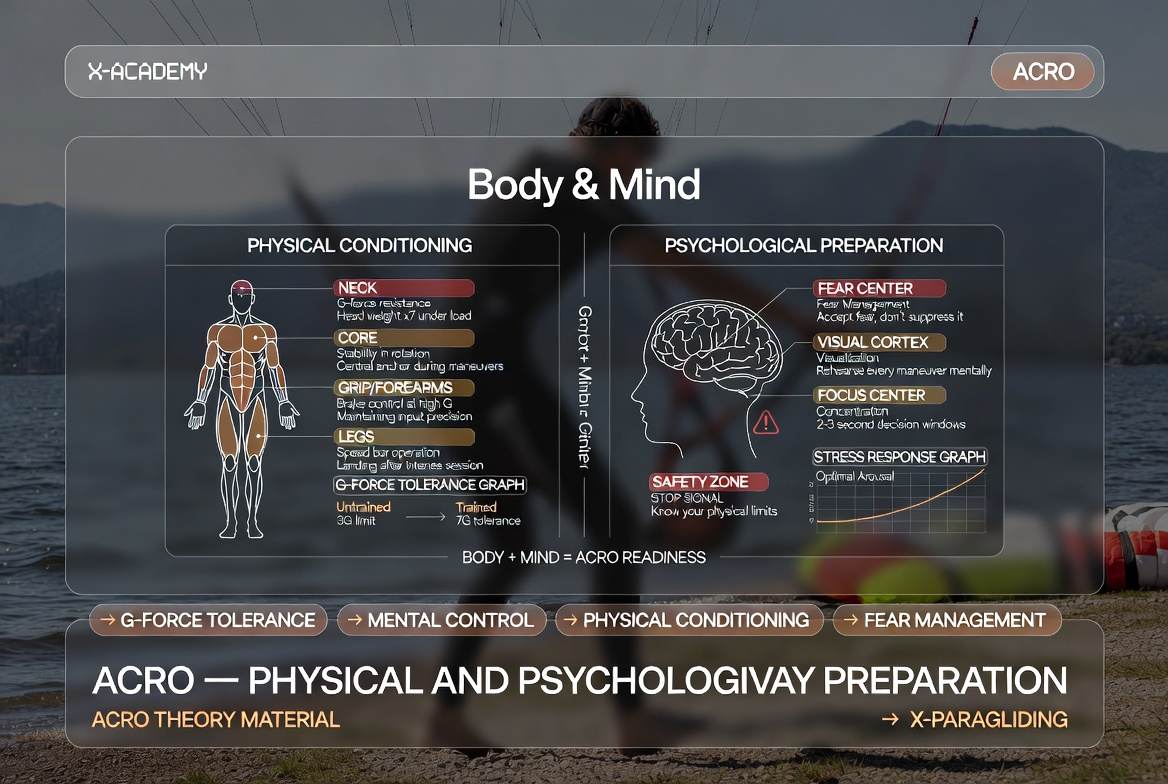
Acro paragliding is not just about wing control; it is a battle with one's own body and mind. When a pilot executes maneuvers pulling 4–7G, their physical and psychological state plays a decisive role in flight safety.
Here are the two most critical aspects of Acro course preparation:
1. Physical Conditioning
An Acro pilot must be an athlete. During maneuvers, the body undergoes immense stress, requiring specific types of endurance:
G-Force Tolerance: In maneuvers like the Spiral Dive or Infinity Tumbling, the pilot experiences intense centrifugal force. This causes blood to pool in the lower extremities, which can lead to G-induced Loss of Consciousness (G-LOC).
Training: Mastering the Anti-G Straining Maneuver (tensing abdominal and leg muscles) to keep blood flowing to the brain.
Neck and Back Strength: An Acro wing reacts with lightning speed. During every Surge or hit, the neck muscles must stabilize the head to prevent whiplash or injury.
Vestibular Apparatus: Frequent rotations cause disorientation and vertigo.
Preparation: Specific exercises on trampolines or gymnastic rings to habituate the brain to rapid spatial rotation.
Endurance: A single Acro flight may last only 5–10 minutes, but energetically, it is equivalent to several hours of standard thermal flying.
2. Psychological Readiness
In Acro, mental resilience is just as vital as technique. Here, fear is a tool used to maintain high levels of alertness.
Fear Management: An Acro pilot must learn to convert fear into concentration. A panic reaction (such as releasing the brakes prematurely) can be fatal in Acro.
Automaticity and Muscle Memory: There is no time to "think" during a maneuver. Responses must occur at the subconscious level.
Method: Visualization — The pilot closes their eyes on the ground and mentally rehearses every second of the maneuver, including hand movements and body positioning.
Combating Disorientation: When the sky and ground swap places several times a second, the pilot must maintain an "internal compass," knowing exactly where the water (the safety zone) is at every moment.
Decision-making Under Stress: If a trick goes wrong, the pilot has only 1–2 seconds to decide: recover the wing or deploy the rescue parachute.
3. The Training Process: "The Principle of Gradualism"
Acro training never begins with complex tricks. Physical and psychological adaptation happens step-by-step:
Simulator: Refining hand movements in a suspended harness on the ground.
SIV Basis: Full control over negative regimes (Stall/Spin), which gives the pilot the confidence that they can recover from any situation.
Training Over Water: The presence of altitude and a water landing zone reduces psychological pressure and grants the pilot the "right to make a mistake."
Summary
Acro piloting is about managing the ego. The best Acro pilots are those who know when to stop and recognize when they are physically or mentally exhausted.
Would you like me to draft a "Physical & Mental Self-Assessment Checklist" for pilots to use before they start an advanced Acro session?