On this page
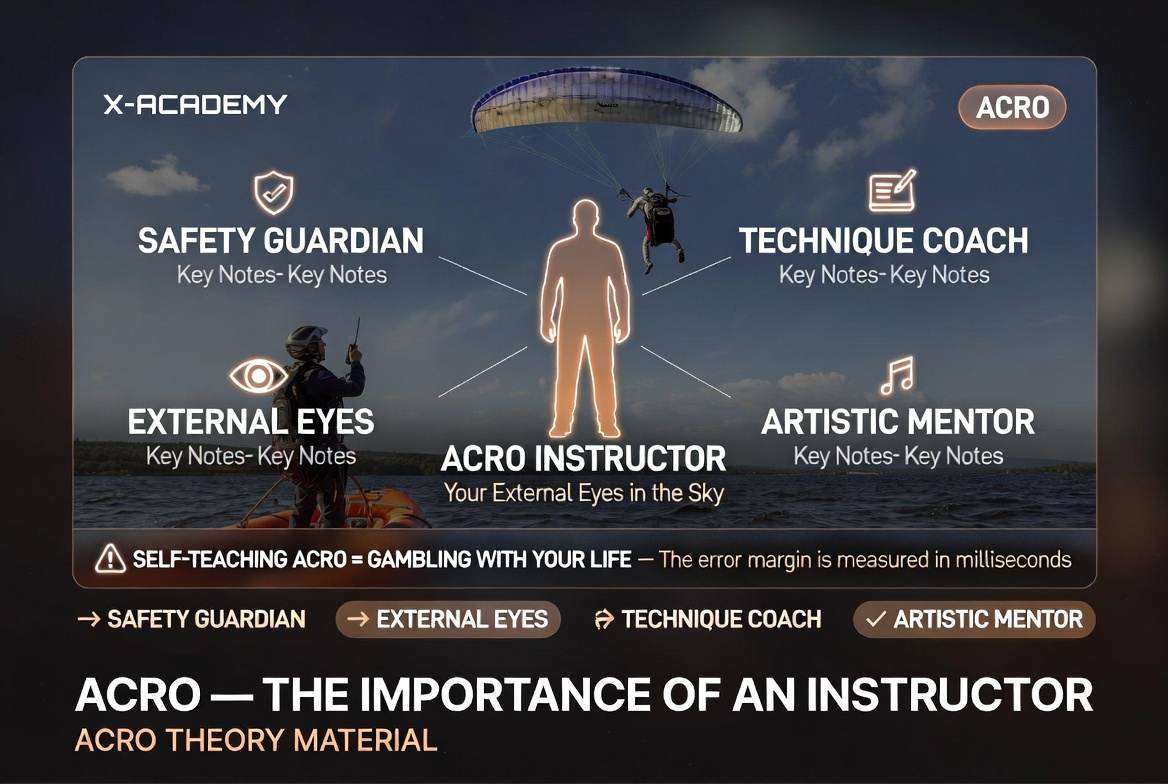
In Acro paragliding, an instructor is not just a teacher—they are your "external eyes" and a guarantee of safety. Without them, self-teaching often results in fatal mistakes. Acro maneuvers are executed in seconds; the window for decision-making is minimal, and the cost of an error is colossal.
Here is why the role of an instructor in Acro is fundamental and irreplaceable:
1. Technical Analyst: "Master of Millimeters and Milliseconds"
In Acro, the line between success and catastrophe often comes down to 10–20 centimeters of brake travel or a fraction of a second.
Video Analysis (Debriefing): The instructor records every flight in high resolution. During evening debriefs, they use slow-motion playback to show you the exact moment a mistake was made. For example, during a Helicopter, raising your hand just 5 cm too high can cause the wing to surge forward dangerously. A pilot might not notice this in the air, but the instructor clarifies it through video.
Perfecting Timing: Acro is about rhythm, not raw strength. An instructor teaches you how to feel the energy peaks (e.g., during a Wingover) and identifies the optimal moment to initiate a maneuver.
2. Psychological Support: "The Art of Managing Fear"
Acro flight involves significant spatial disorientation and immense physical pressure.
Adapting to G-load: When the body experiences 5–6G, a pilot can become confused or panic. The instructor prepares you psychologically, teaching breathing techniques and muscle-tension methods to prevent G-LOC (loss of consciousness).
Restoring Orientation: During vertical rotations like Tumbling, it is easy to lose track of the horizon. The instructor teaches you how to find fixed points on the horizon to maintain calm and situational awareness.
3. Living Safety Guarantee: "Radio Control"
This is the instructor's most critical function.
Timely Response: When a maneuver "breaks" (e.g., a SAT transitions into a dangerous spiral), a pilot often continues to fight long after it is too late. The instructor provides strict, short commands via radio: "Release!", "Stall!", or "Throw Reserve!". These seconds are often life-saving.
Exit Algorithms: The instructor dictates the safest path to exit a maneuver, preventing "cascading" incidents where one mistake triggers another.
Why Video Tutorials Cannot Replace an Instructor
While the internet is full of tutorials, they cannot see your specific mistakes.
Personalized Approach: Every pilot has a unique "handwriting." An instructor identifies if you have a tendency toward over-correction and fixes it in real-time.
Safe Environment: An instructor chooses the specific flight time, altitude, and location (usually over water) to minimize risk.
Mental Peace of Mind: Knowing that an experienced professional is watching and guiding you makes your progress three times faster because fear no longer paralyzes you.
Summary
In Acro, the instructor is your "safety cushion." Their primary goal is to bring you to a level where your muscle memory and analytical mind can independently manage any crisis.