On this page
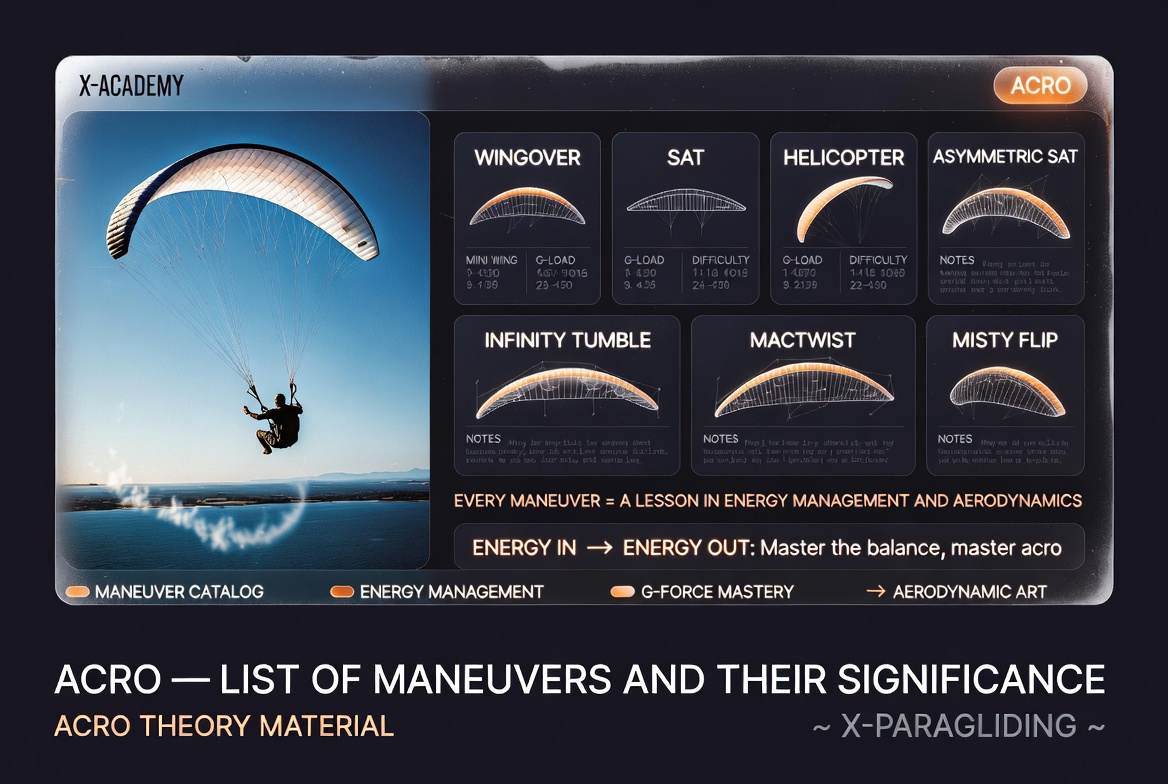
Mastering Acro (Aerobatics) maneuvers is not just about learning beautiful tricks; it is the ultimate school of energy management and aerodynamics. Every maneuver forces the pilot to feel the slightest change in wing pressure and manage G-loads that are unimaginable in standard flight.
Here is an in-depth and extensive analysis of Acro maneuvers:
1. Wingover – The Foundation of Acro
The Wingover is considered the "alphabet" of Acro, yet performing it perfectly is one of the most difficult challenges.
The Essence: This is a rhythmic oscillation of the wing (Roll), where with every turn, the pilot climbs higher until they swing above the level of the wing.
Significance: Here, the pilot learns Timing. If you pull the brake too early or too late, the high side of the wing (the tip) will lose pressure and collapse.
What it grants you: Once the Wingover is mastered, the pilot can transform any dynamic hit in turbulent air into manageable energy.
2. SAT – A Revolution in Rotation
The SAT (named after its creator Raul Rodriguez’s "Safety Acro Team") is the first maneuver where the center of rotation shifts.
The Essence: In a standard spiral, the center of rotation is inside the wing. During a SAT, the pilot enters a strong rotation and uses a specific brake input to "turn" the wing so that the pilot moves backward while the wing moves forward. The axis of rotation passes through the lines between the pilot and the wing.
Significance: This is the first step toward stable rotation. The pilot learns to withstand high G-loads and maintain orientation while the world spins around them at incredible speeds.
3. Helicopter – The Pinnacle of Negative Regimes
This is one of the most elegant and technical maneuvers in Acro.
The Essence: The wing is in a stable negative spin. It is fully inflated and rotates around a vertical axis, with the pilot positioned exactly under the center of the wing.
Significance: The Helicopter requires millimeter precision. Here, the pilot learns to hold the brakes at that exact threshold where the wing neither stalls nor flies forward.
Practical Benefit: This maneuver gives the pilot such a high level of "wing feel" that they can stop any unintentional spin in seconds.
4. Misty Flip – Dynamics and Coordination
This is a maneuver that requires perfect command over energy.
The Essence: The pilot performs a high wingover or an asymmetric spiral to build massive energy, and then, at the moment the wing "releases," forces it into a 360-degree negative rotation.
Significance: During a Misty Flip, there is a rapid transformation of energy from vertical to rotational. It is a true test of coordination at extreme speeds.
5. Tumble and Infinity Tumbling – The "Gold Standard"
This is the most aggressive and spectacular part of paragliding.
Tumble: The pilot flips vertically over the top of the wing. Imagine the wing staying in place while you "jump" over it. The G-load here is at its peak.
Infinity Tumbling: This is a continuous chain of Tumbles. The pilot regenerates energy on every rotation to go over the top of the wing again and again.
Significance: This maneuver requires the highest physical endurance (loads exceeding 6G) and psychological fortitude. Performing the Infinity Tumbling means the pilot has 100% command of the wing in every dimension.
Why are these maneuvers significant?
Studying Acro maneuvers transforms a pilot into an "Aerodynamic Athlete." For an ordinary pilot, a critical situation (such as strong rotation or a spin) is a source of fear; for an Acro pilot, it is a workplace environment.
Acro grants you:
Automatic Reflexes: You no longer think about what you are pulling—your body reacts on its own.
Spatial Orientation: In any position (upside down or backward), you know exactly where the ground is and where the wing is.
Confidence in Equipment: You know the absolute maximum capabilities of your wing.