On this page
An Acro (Aerobatics) Course is the "high-performance piloting" of paragliding, where a pilot learns to command the wing in extremely dynamic and aggressive regimes. It is an art form that demands mathematical precision, physical endurance, and a perfect feel for the wing.
Here is a detailed overview of the Acro course:
1. List of Acro Maneuvers and Their Significance
Acro maneuvers are categorized by difficulty, each requiring the pilot to master a new set of skills:
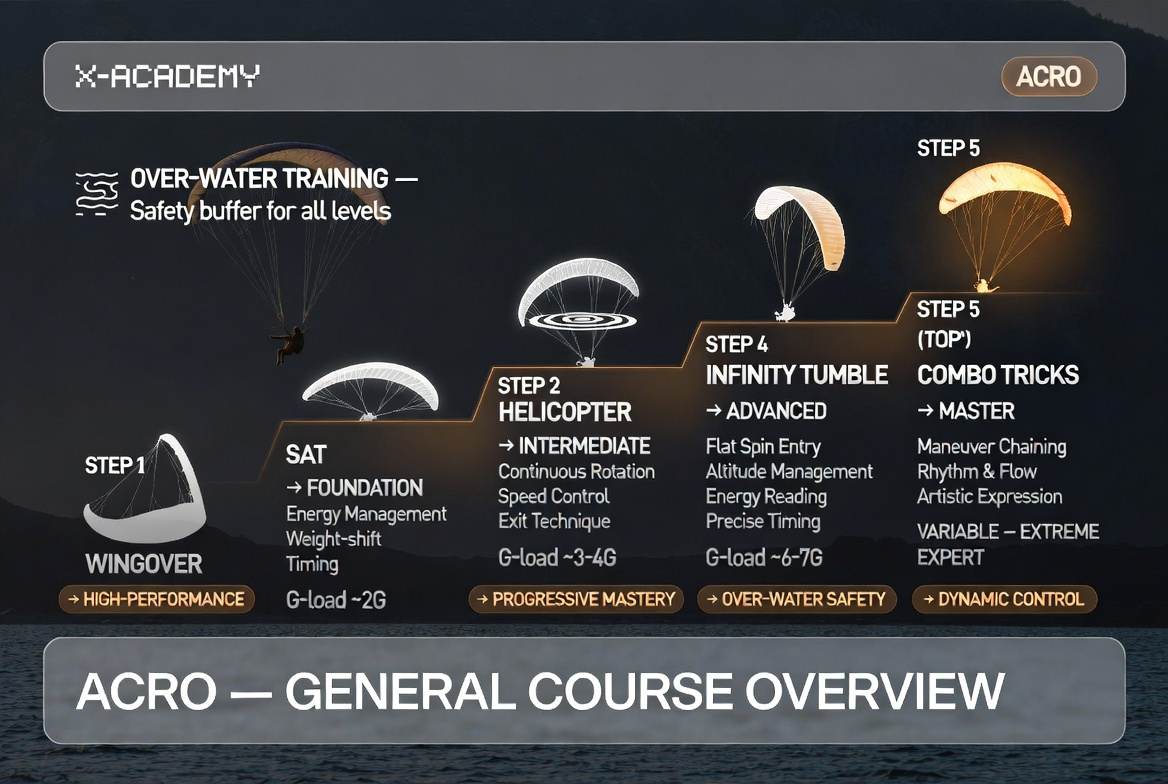
Wingover: The "alphabet" of Acro. The pilot builds energy and swings high above the wing.
Significance: Perfecting energy management and timing.
SAT: The wing rotates forward while the pilot rotates backward, with the center of rotation between them.
Significance: The first step toward stable rotational maneuvers.
Helicopter: The wing spins around its vertical axis like a propeller.
Significance: Absolute control over negative regimes (Spin).
Misty Flip: A dynamic maneuver that starts from a wingover and concludes with a 360-degree rotation.
Significance: A test of coordination at extreme speeds.
Tumble: The pilot flips vertically over the top of the wing (Looping).
Significance: Peak dynamics where G-force reaches its maximum.
Infinity Tumbling: Multiple, continuous repetitions of the Tumble.
Significance: The "Gold Standard" of Acro and the basis for world records.
2. Equipment Standards
During Acro flights, the load on the wing and pilot can reach
4-7G
, so specialized equipment is mandatory:
Acro Wing: Smaller, faster, and more maneuverable wings (typically 16–20 sq.m). They feature reinforced structures and lines.
Acro Harness: A specialized harness designed for high G-loads. It must contain two rescue parachutes (at least one should be a Rogallo type—steerable).
D-Shackles / Quick-outs: Reinforced carabiners that can withstand extreme shock loads.
Anti-G Drogue: A small drag chute used to reduce G-load during spiral maneuvers.
3. The Importance of an Instructor in Acro
Self-teaching in Acro is dangerous. An instructor serves as:
Technical Analyst: Uses video analysis to show you brake inputs down to hundredths of a second.
Psychologist: Helps you overcome the fear of high G-loads and spatial disorientation.
Safety Monitor: Provides radio guidance to exit a maneuver if the situation goes out of control.
4. Daily Training Syllabus
An Acro course typically lasts 5–7 days:
Morning (Theory): Analyzing the physics of maneuvers and practicing on a simulator (suspended in a harness).
Flight 1 (Energy): High wingovers and spirals to build and manage energy.
Flight 2 (Maneuvering): Working on SATs or stall-based tricks.
Flight 3 (Combinations): Linking tricks together (e.g., exiting a SAT directly into a Stall).
Evening (Debriefing): Frame-by-frame video analysis of the day’s flights.
5. The Spectacle and International Competitions
Acro paragliding is the most "photogenic" discipline in the sport.
The Show: Smoke effects, synchronized flights (two pilots performing tricks in unison), and flying to music.
Major Competitions:
Acro World Tour (AWT): A tour featuring the world's elite pilots.
Acromax (Italy): One of the most prestigious competitions in the circuit.
Sonchaux Acro Show (Switzerland): A grand festival held over Lake Geneva.
Judging Criteria: Technical difficulty, flow of execution, and landing on a floating platform (Raft Landing).
Summary
An Acro course is the path of transforming a pilot into an athlete. It is an extreme discipline where the margin for error is minimal, but the sense of self-realization is maximal.