

On this page
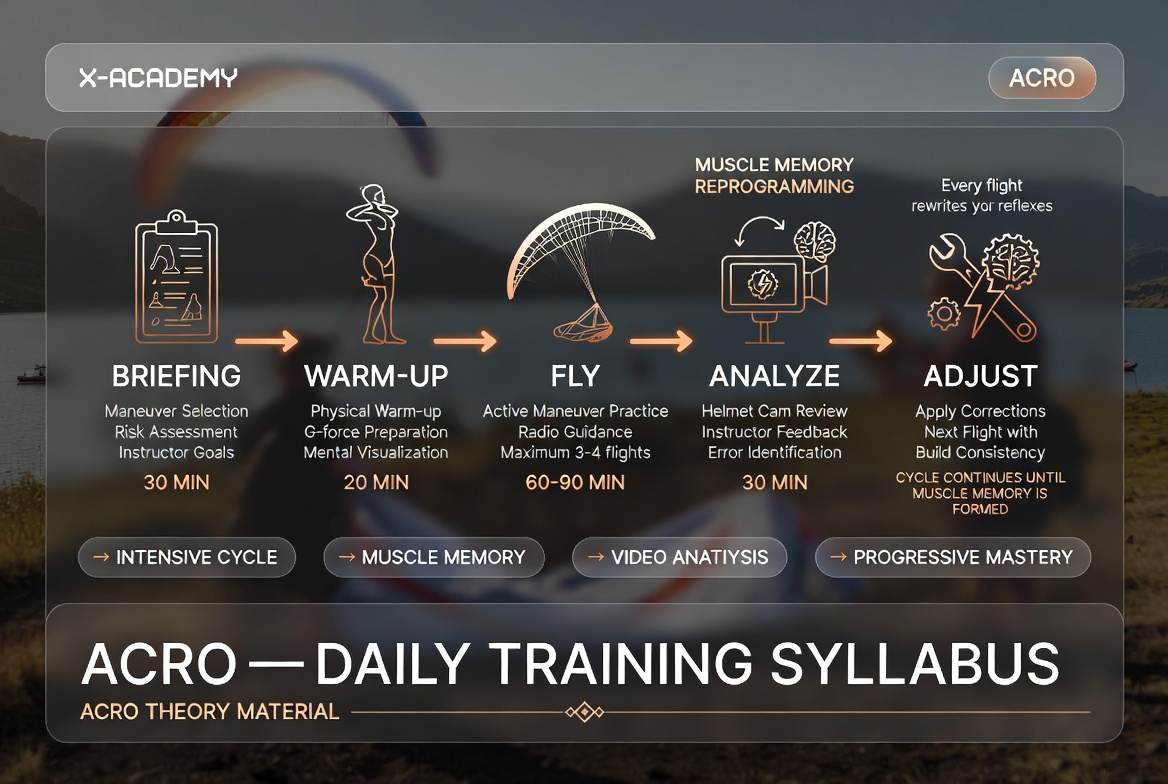
An Acro (Aerobatics) Course daily plan is not just a schedule of flights—it is an intensive technical and physical cycle where each stage serves to "reprogram" the pilot's muscle memory. Progress in Acro is directly linked to discipline and the in-depth analysis of every single flight.
Here is an extensive overview of a standard Acro course daily plan:
1. Morning Theory Block and Simulator
Before a pilot takes to the air, every second of a maneuver must be conceptualized on the ground.
Physics of the Maneuver: The instructor explains force vectors on a whiteboard. For example, during a SAT, where the center of rotation is located and how the pressure on the wing changes. The pilot must know not only what to pull, but why.
Simulator (Suspended Harness): The pilot sits in a suspended harness and mimics hand inputs at the instructor's command. This is essential so that in the air, under a 5G load, the pilot does not confuse their left from their right, ensuring reactions remain automatic.
2. Flight 1: Energy Management (The Power-up)
Most Acro maneuvers require high speed and inertia. The first flight is always dedicated to the "fundamentals."
High Wingovers: The pilot works on amplitude. The goal is to accumulate energy while keeping the wing as stable as possible.
Asymmetric Spirals: This is the "fuel" for Acro maneuvers. The pilot learns how to enter and exit strong rotations into a controlled position.
3. Flight 2: Specific Maneuver Refinement
This flight shifts the focus to the specific trick the pilot is currently learning.
Maneuvering: If the target is a Helicopter, the pilot spends the entire flight finding the stall threshold and maintaining the wing in a negative regime.
Precision: The instructor corrects every centimeter of brake travel via radio. Every attempt concludes with an immediate analysis in the air before the next try.
4. Flight 3: Combinations and Cascades
This is the culmination of the day, where the pilot links different maneuvers together.
Transitions: The most difficult part of Acro is moving from one trick to another—for example, exiting a SAT and immediately transitioning it into a Full Stall.
Automaticity: The pilot becomes accustomed to the idea that the end of one maneuver is the beginning of the next. This develops incredible concentration and physical endurance.
5. Evening Debriefing
This is the most critical part of the day. Due to the high dynamics of Acro, pilots often fail to notice many details while in the air.
Video Analysis: The instructor breaks down the flights frame-by-frame. The pilot might see, for instance, that releasing the brake just 0.5 seconds too early caused the wing to collapse.
Error Cataloging: Every mistake is identified, and the plan for the next day is set specifically to correct those errors.
Mental Preparation: Visualization of the next day's maneuvers takes place.
Why is this plan decisive?
Acro is not chaotic flight; it is a sport of mathematical precision.
Progression: You do not move on to a Tumble until your Wingover is perfect.
Safety: Each day reduces risk because the pilot's confidence is built on knowledge, not luck.
Efficiency: With such an intensive schedule, a pilot achieves more progress in one week than in an entire year of independent practice.