On this page
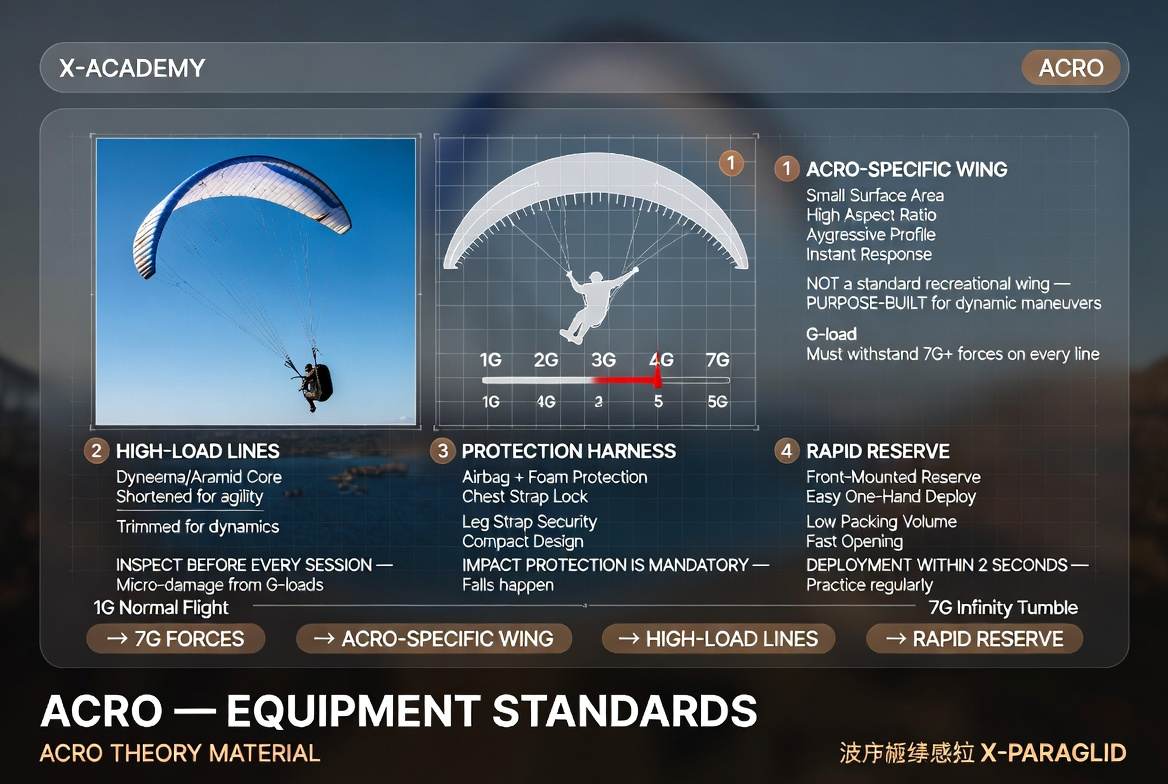
In Acro (Aerobatics) paragliding, equipment is not just a tool for flight—it is a life-support system operating at the absolute limits of physical possibility. When G-loads reach 7G during a maneuver, your effective weight increases sevenfold. This places colossal stress on every line, carabiner, and harness attachment point.
Here is an in-depth overview of Acro equipment standards:
1. Acro Wing – Aggressive Aerodynamics
An Acro wing differs radically from standard paragliding aircraft.
Small Surface Area and High Loading: Acro wings are typically $16-20$ sq.m. A smaller surface area translates to higher speed and greater energy. The higher the specific wing loading, the more stable the wing remains during maneuvers, though it demands much faster reaction times from the pilot.
Reinforced Internal Structure: The internal ribs and diagonal walls are constructed from heavy-duty fabrics to withstand the "shocks" of Infinity Tumbling or aggressive stalls.
Line Systems: Acro wings utilize reinforced, often thicker, and less elastic lines to prevent snapping or permanent deformation under high loads.
2. Acro Harness – The Pilot’s "Armor"
An Acro harness is engineered to merge the pilot and the equipment into a single, cohesive unit.
Dual Reserve System: This is the gold standard of Acro. An Acro harness features two separate compartments for rescue parachutes.
Rogallo-type Reserve: At least one reserve should be steerable (Rogallo). If the main wing becomes entangled at low altitude, a Rogallo allows you to steer your descent and avoid dangerous obstacles.
Geometry and Sensitivity: Acro harnesses have a tighter fit and higher hang points. This configuration allows the pilot to feel the wing's dynamics more acutely and execute weight shifts with maximum efficiency.
3. Carabiners and Connection Systems
Standard aluminum carabiners are strictly prohibited in Acro due to the risk of metal fatigue.
Steel D-Shackles: Many Acro pilots use steel D-shackles, which are virtually impossible to break or accidentally open during flight.
Quick-Out Release: These specialized carabiners allow you to instantly jettison the main wing after deploying a reserve. This is critical in high winds or water landings to prevent the main wing from dragging or entangling the pilot.
4. Anti-G Drogue – The G-Load Brake
Extreme G-loads affect not only the equipment but the pilot's body, potentially leading to G-LOC (G-force induced Loss of Consciousness).
Operating Principle: The Anti-G is a small drag chute attached to the side of the harness. It creates additional drag during spiral rotations, reducing centrifugal force by 30-40%.
Significance: It is essential for modern, high-efficiency wings that accumulate massive energy during high-speed spirals.
Summary: Why Are These Standards Critical?
Equipment failure in Acro is almost always fatal because maneuvers are performed at high speeds and high energy relative to the ground.
Safety Reserve: Specialized gear provides the guarantee that the wing will not disintegrate mid-air.
Efficiency: The wing and harness are tuned to the pilot’s every movement, making maneuvers cleaner and more controlled.
Mental Peace of Mind: Knowing that your carabiners and lines are rated for extreme loads allows you to focus entirely on the execution of the maneuver.