

On this page
For a P4-level pilot, digital instruments are no longer just "variometers." They constitute your "cockpit," providing critical information regarding airspace, optimal glide, and competition tactics.
Here is the in-depth English translation of these core topics:
1. Flight Computers & Apps: Digital Assistants
A P4 pilot must be able to do more than just turn on a program; they must interpret its data in real-time.
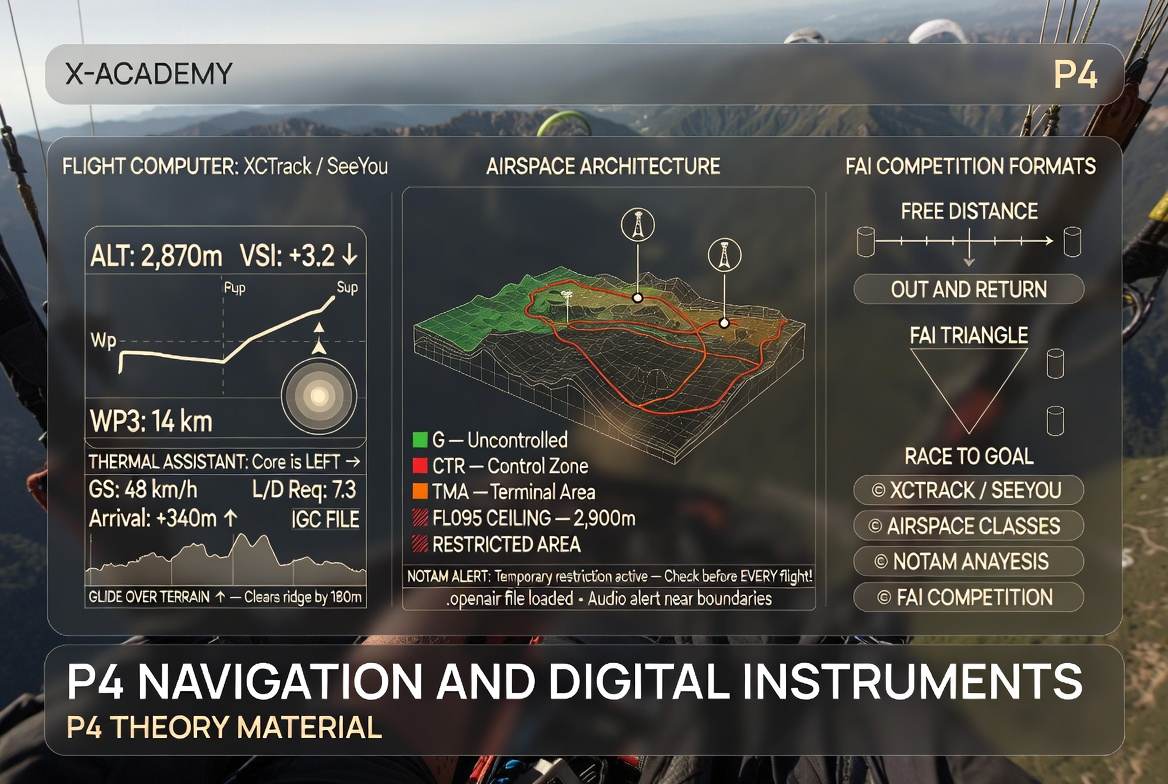
XCTrack & SeeYou Navigator: These are the industry standards. At the P4 level, a pilot must master:
Thermal Assistant: A graphical representation showing the thermal core and its drift relative to the wind.
Glide over Terrain: The software predicts whether you can clear a specific ridge based on your current altitude, wing performance, and wind.
File Management: Recording IGC files and analyzing them post-flight (Debriefing).
Integrated Variometers (e.g., Naviter Oudie, Skytraxx): Their advantage lies in sunlight-readable screens and high-precision sensors, which are essential for staying aloft in weak thermals.
2. Airspace & Law: Aviation Law and NOTAM
During a cross-country flight, you cross various legal zones. Violating them is dangerous for both safety and the reputation of the sport.
Airspace Classification: You must understand the differences between CTR (Control Zone), TMA (Terminal Control Area), and Restricted Areas.
NOTAM (Notice to Airmen): Operational information regarding temporary changes in airspace (e.g., military exercises, rescue operations). A P4 pilot is obligated to check NOTAMs before every XC flight.
Airspace Files (.txt / .openair): Files loaded into your flight computer (like XCTrack) that provide audible warnings if you approach restricted zones.
3. FAI Rules and Competition Formats
P4 pilots often transition into a competitive mindset. This requires knowledge of the Fédération Aéronautique Internationale (FAI) rules.
Distance Types:
Free Distance: Flying to the maximum possible distance.
Out and Return: Flying to a waypoint and returning (yields higher points).
FAI Triangle: A triangle where the shortest leg is at least 28% of the total distance. This is considered the "academic" peak of XC flying.
Task Roles:
Race to Goal: Competing to pass through pre-defined cylinders in the shortest time.
Optimized Route: How to clip the radius of a waypoint (Sector) while covering the minimum total distance.
WXC (World XContest): Using online platforms to upload flights and participate in global rankings.
4. Connectivity and Safety
LiveTrack: A P4 pilot should utilize systems (e.g., Flymaster, OGN, Garmin inReach) that display their location in real-time. This is critical for retrieve teams in unfamiliar territory.
Radio Etiquette: Professional use of radio communication, especially during group flights or high-stakes competitions.