On this page
For a P4-level pilot, flight safety is no longer just about fixing a "collapse"; it is about total wing management at the edge of its aerodynamic limits.
Here is the in-depth English analysis of these critical topics:
1. Advanced SIV Theory
A P4 pilot must master maneuvers that allow them to "restart" the wing in any situation.
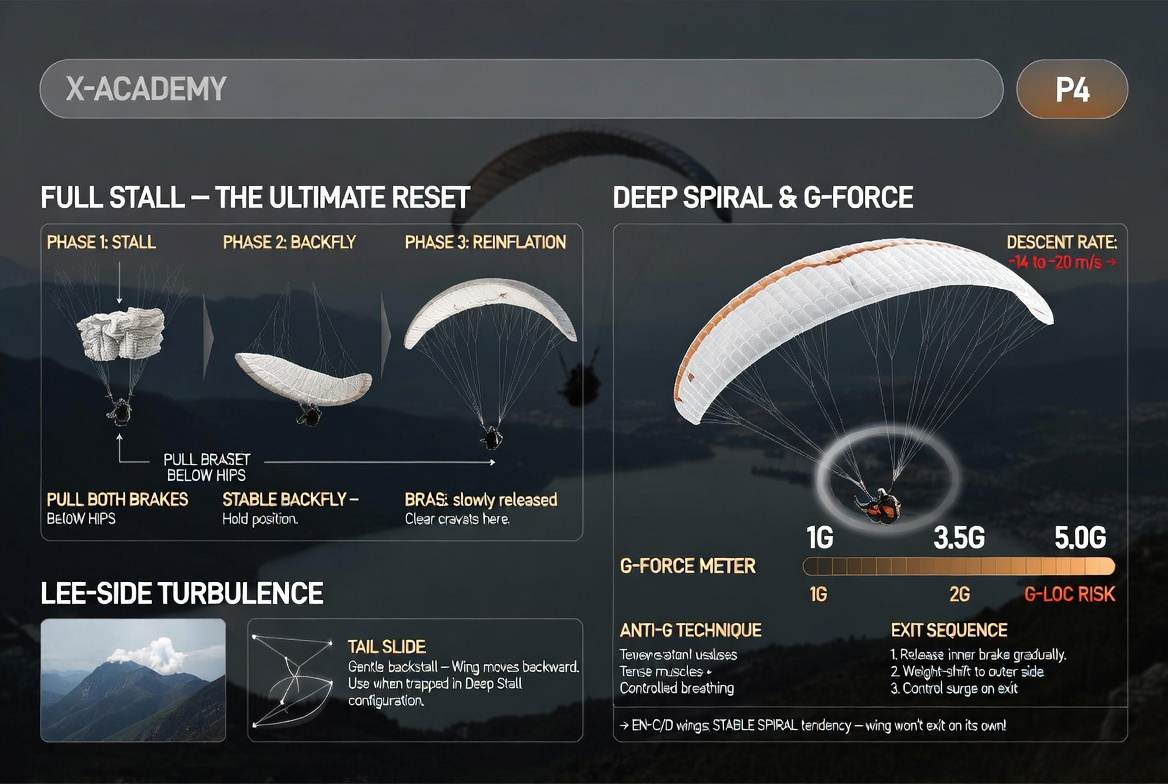
Full Stall: This is the most vital safety maneuver. Its purpose is to completely stop the wing to "clear" it of any knots (Cravats) or dangerous configurations.
Phases: Entry (Stall), Stabilization (Backfly), and Controlled Exit. A P4 pilot must know how to hold the wing in a stable Backfly until they find enough airspace for a safe reinflation.
Tail Slide: A gentler version of a Full Stall where the wing moves backward while maintaining its shape. This maneuver is critical if the wing gets "stuck" in a parachutal state (Deep Stall).
2. Deep Spiral and $G$-force
The most effective method for rapid altitude loss (e.g., during Cloud Suck), though it requires high physical and mental preparation.
Managing $G$-force: In a steep spiral, a pilot experiences $3.5$ to $5.0$ $G$s. A P4 pilot must know "Anti-G" techniques (muscle tensing and specific breathing patterns) to prevent a loss of consciousness (G-LOC).
Safe Exit: High-performance wings (EN-C/D) often maintain inertia during a spiral exit (Stable Spiral). The pilot is responsible for actively "leading" the wing out of the spiral by gradually releasing the inner brake and controlling the outer brake to prevent a massive Surge.
3. Incident Prevention and Terrain Aerodynamics
Prevention means ensuring you never enter an extreme situation in the first place. Reading the terrain is essential for this.
Lee-side Turbulence: The XC pilot’s greatest enemy. When wind crosses a ridge, it creates a "Rotor" behind it—a chaotic, descending, and turbulent mass of air.
The Rule: Never fly at low altitudes on the lee side of a ridge if the wind speed exceeds $15\text{--}20\text{ km/h}$.
Trigger-point Turbulence: Areas where a thermal breaks away from the ground are often characterized by "sharp" turbulence. A P4 pilot prepares to catch the wing (Active Piloting) before a collapse occurs.
4. Active Piloting
At the P4 level, this becomes a subconscious reflex. The pilot manages the wing not just with brakes, but through:
C-Riser Control: On modern 2-liner and 3-liner wings, stability while flying on the speed bar is controlled via the rear risers. This allows you to feel pressure variations and react before a collapse happens.