On this page
At the P4 level, Cross-Country (XC) flying is no longer just about "surviving" from one thermal to the next. It is a mathematical and strategic game where the goal is to maximize both speed and distance.
Here is the in-depth English breakdown of these fundamental topics:
1. Speed to Fly (MacCready Theory)
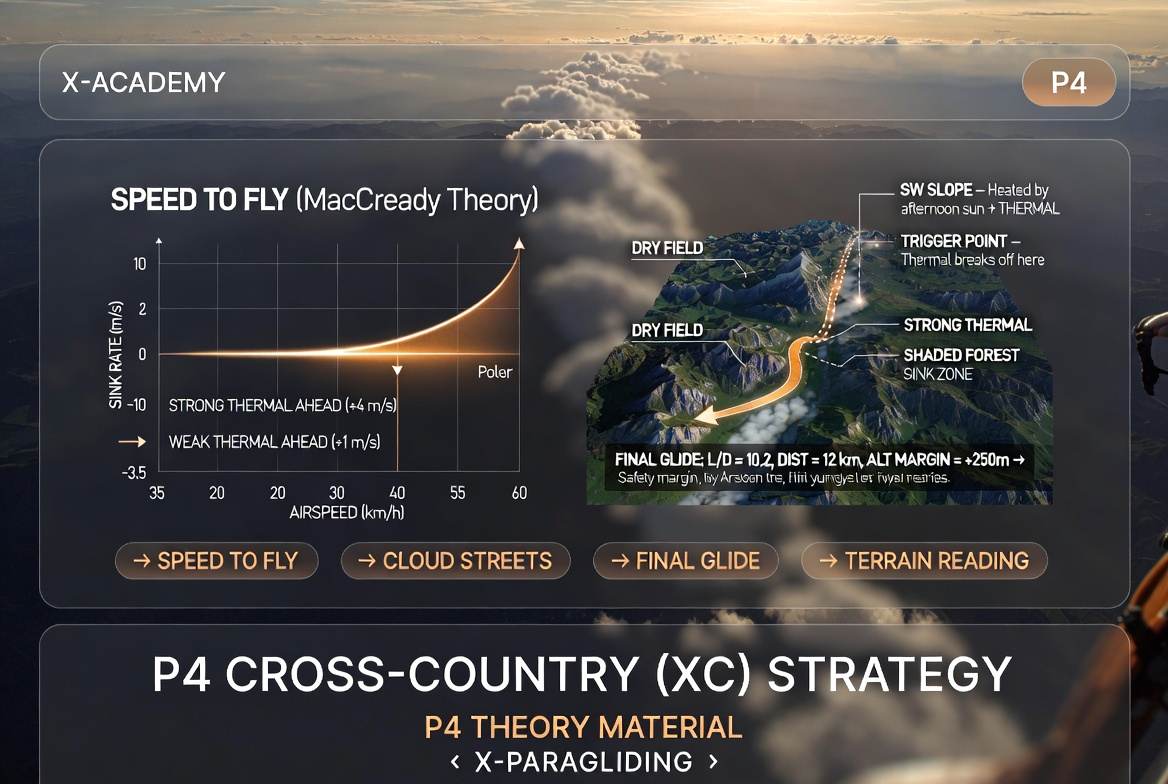
This is the "Golden Formula" of XC flying. MacCready theory answers the critical question: At what speed should I glide to the next thermal?
The Principle: If you know (or predict) that the next thermal will be strong (e.g., $+4\text{ m/s}$), you should fly fast (using the speed bar) to spend less time in "dead" air. If the next thermal is expected to be weak ($+1\text{ m/s}$), you should fly slower to conserve altitude.
Sinking Air (Sink): The stronger the downdraft during a transition, the faster you must fly to exit that zone. A P4 pilot instinctively modulates the speed bar with every "sink" tone from the variometer.
2. Route Optimization and "Cloud Streets"
A P4 pilot does not build a route in a straight line; they follow "lines of energy."
Cloud Streets: When the wind aligns thermals in a row, it creates a "highway." Here, you can fly for kilometers without circling, simply by modulating your speed. These are the most efficient segments of any route.
Wind Correction: Sometimes a $10\degree$ deviation from the direct path—to reach better terrain or a promising cloud—ultimately makes you faster than flying in a straight line.
3. Final Glide (The Final Phase)
This is the moment you stop circling in a thermal and commit to the finish line (or the LZ).
L/D (Lift/Drag) Calculation: Your flight computer (e.g., XCTrack) knows your wing's polar curve. It calculates wind, your current altitude, and the remaining distance.
Safety Margin: A P4 pilot never calculates a final glide to arrive at "zero." You should always maintain a buffer of at least $200\text{--}300\text{ meters}$ to account for unexpected sink or increasing headwinds.
4. Terrain Reading
When flying over unfamiliar terrain, the pilot becomes a "detective." You must visualize invisible thermals using visual cues:
Aspect (Exposure): Which slope is being heated most perpendicularly by the sun? (e.g., a southwest slope in the late afternoon).
Thermal Triggers: Where does the heated air break away from the ground? A rocky peak, the edge of a forest, or a village road—these are the points where a thermal is "born."
Wick Effect: How is smoke or dust moving on the ground? This provides vital information about the thermal core before you even enter it.
Why is this important?
For a P3 pilot, flying $20\text{ km}$ is a success. For a P4 pilot, success is flying $100\text{ km}$ through optimal time management. This knowledge allows you to be more than just a passenger—you become a true captain of the skies.