On this page
For a P4-level pilot, meteorology is no longer just a "will it rain or not" forecast. It is the ability to create a three-dimensional model of the atmosphere in the mind.
Below is the in-depth professional breakdown of these topics:
1. In-depth Analysis of Skew-T / Log-P Diagrams
This is the result of aerological sounding, showing the state of the atmosphere from the surface to the stratosphere. A P4 pilot must be able to identify:
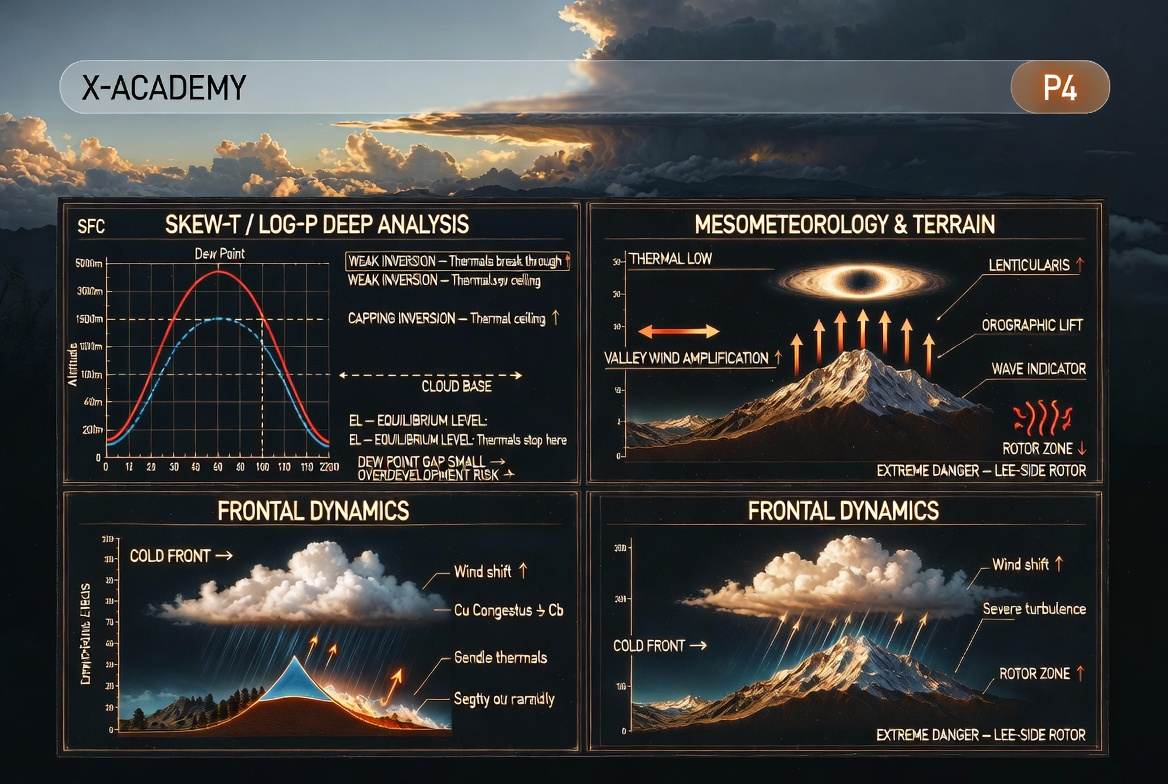
Recognition of Inversion Layers: A rightward shift of the temperature curve on the diagram indicates an inversion. The pilot must determine if this is a "Capping Inversion," which will trap thermals at low altitudes, or a weak layer that can be breached.
EL (Equilibrium Level): The point where a thermal stops rising. This represents your real "ceiling."
Humidity and Spread: The distance between the temperature and Dew Point curves indicates how dry the air is. If the curves are close, expect low, thick cloud cover or Overdevelopment.
2. Mesometeorology and Terrain Influence
Mesometeorology studies processes within a radius of 10 to several hundred kilometers. In the mountains, general forecasts often fail to account for local shifts.
Thermal Lows: Intense heating of large massifs (e.g., the Caucasus Mountains) creates local low pressure that "sucks" air from the plains. This can cause Valley Winds to strengthen to dangerous levels.
Orographic Lift: The mechanical lifting of wind over a ridge, which often leads to the formation of "cloud caps" (Lenticularis). A P4 pilot must know when this process will transition into Wave flight or a dangerous Rotor.
3. Dynamics of Frontal Systems
While on a cross-country route, a pilot may encounter frontal changes that must be recognized in the air:
Cold Front: Heavy cold air rapidly displaces a warm mass. Result: Sharp turbulence, rapid shifts in wind direction, and a high probability of thunderstorms. A P4 pilot spots an approaching cold front by identifying Cumulus Congestus (towering clouds).
Warm Front: Warm air slowly overrides cold air. This causes stratiform cloudiness (Cirrus, Altostratus) and the gradual suppression of thermal activity.
4. Convergence (Convergence Zones)
This is a "free ticket" to covering great distances if you know how to find it.
Formation Mechanism: When two different air masses (e.g., a sea breeze and a valley wind, or flows from two different valleys) meet, the air has nowhere to go but up.
Visual Cues: A convergence zone is often indicated by a line of clouds that does not align with the general wind, or a "wall" of haze and dust in the air.
Tactics: Along a convergence line, a pilot can fly for kilometers without circling, staying in a constant upward flow. This is the highest level of XC flight technique.
Why is this critical for a P4?
A P3 pilot reacts to what they feel (the variometer). A P4 pilot predicts based on what they see and analyze. This knowledge allows you to plan a route in conditions where others believe "there is no flyable weather."