On this page
For a P4-level pilot, equipment is no longer just a "wing and a harness." It is a high-tech system where even a minor adjustment—such as adding ballast or fine-tuning harness settings—can have a dramatic impact on flight performance.
Here is the in-depth English translation of these advanced equipment topics:
1. Wing Certification and Construction (EN-C/D)
At the P4 level, pilots transition to high-performance wings where the primary difference lies not just in speed, but in the internal architecture of the glider.
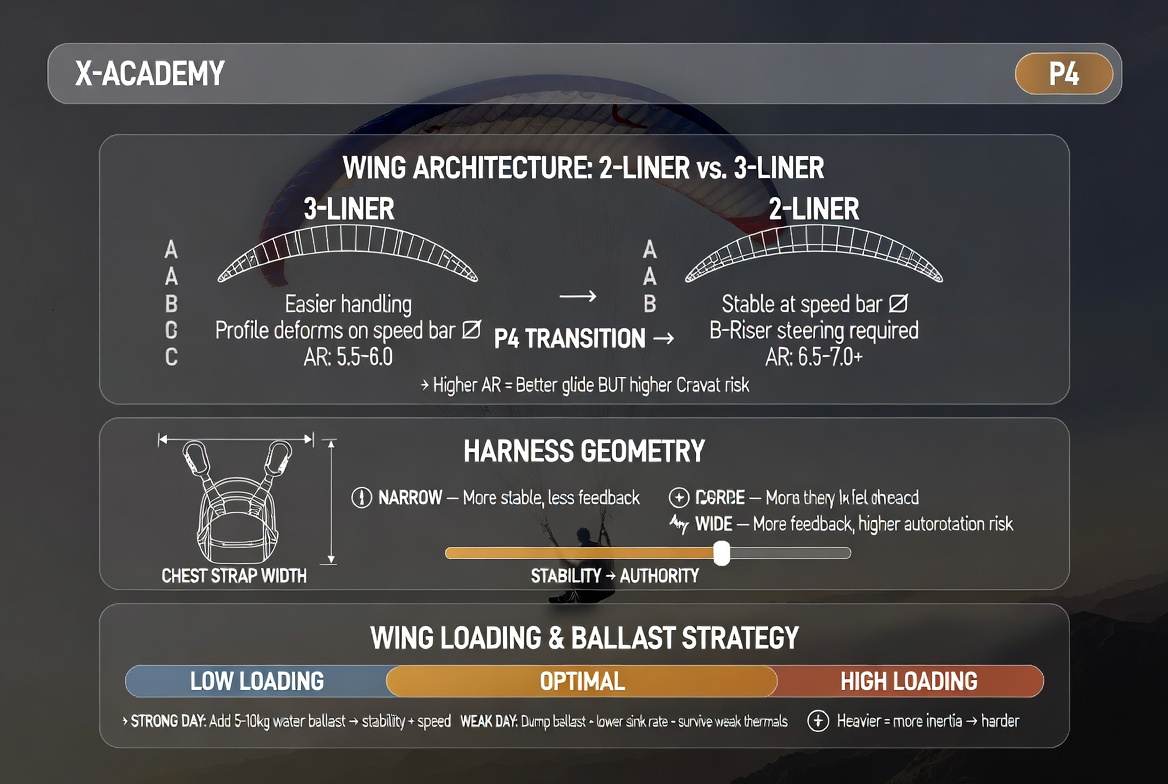
2-Liner vs. 3-Liner:
3-Liner: The standard construction with A, B, and C rows. While easier to manage, the wing profile deforms more while on the speed bar, which increases drag.
2-Liner: Features only A and B rows. Previously reserved for competition (CCC) wings, this technology is now available in the EN-C class. 2-liners are significantly more stable on the speed bar and allow for efficient pitch control via the B-risers without losing performance.
Aspect Ratio: EN-C/D wings have a high aspect ratio ($6.0\text{--}7.0+$). This provides a superior glide ratio, but the wing is more prone to Cravats (knots) during a collapse.
2. Harness Geometry
The harness is your "interface" with the air. Improper adjustment can directly compromise wing safety.
ABS (Anti-Balance System) and Chest Strap: The width of the chest strap (distance between carabiners) directly affects wing stability.
Narrow Setting: The wing is more stable, but the pilot receives less "feedback" from the air, making it harder to locate the thermal core.
Wide Setting: The wing is more sensitive and easier to maneuver, but the risk of autorotation (falling into a spiral) during a collapse increases.
Stability vs. Authority: A P4 pilot must find the "sweet spot" where the harness provides enough information without becoming overly "loose" in turbulent air.
3. Use of Ballast (Wing Loading)
In XC flying, weight is your ally if you know how to manage it.
Wing Loading: The higher the loading (kg/$m^2$), the more stable the wing remains in turbulence and the higher its Trim Speed.
Ballast Strategy:
Strong Conditions: Pilots add water ballast ($5\text{--}10\text{ kg}$) to make the wing "heavy," allowing it to cut through the wind better and resist collapses.
Weak Conditions: It may be necessary to dump ballast to decrease the Sink Rate, allowing the pilot to climb out in weak thermals.
Inertia: A heavy wing has more inertia, which helps in "piercing" through thermals, but it requires more physical input when performing maneuvers.
Why is this important?
At the P4 level, your equipment must be optimized for your weight and flying style. A pilot who does not understand their harness geometry or fails to use ballast when necessary loses 20-30% of their wing's true potential.