On this page
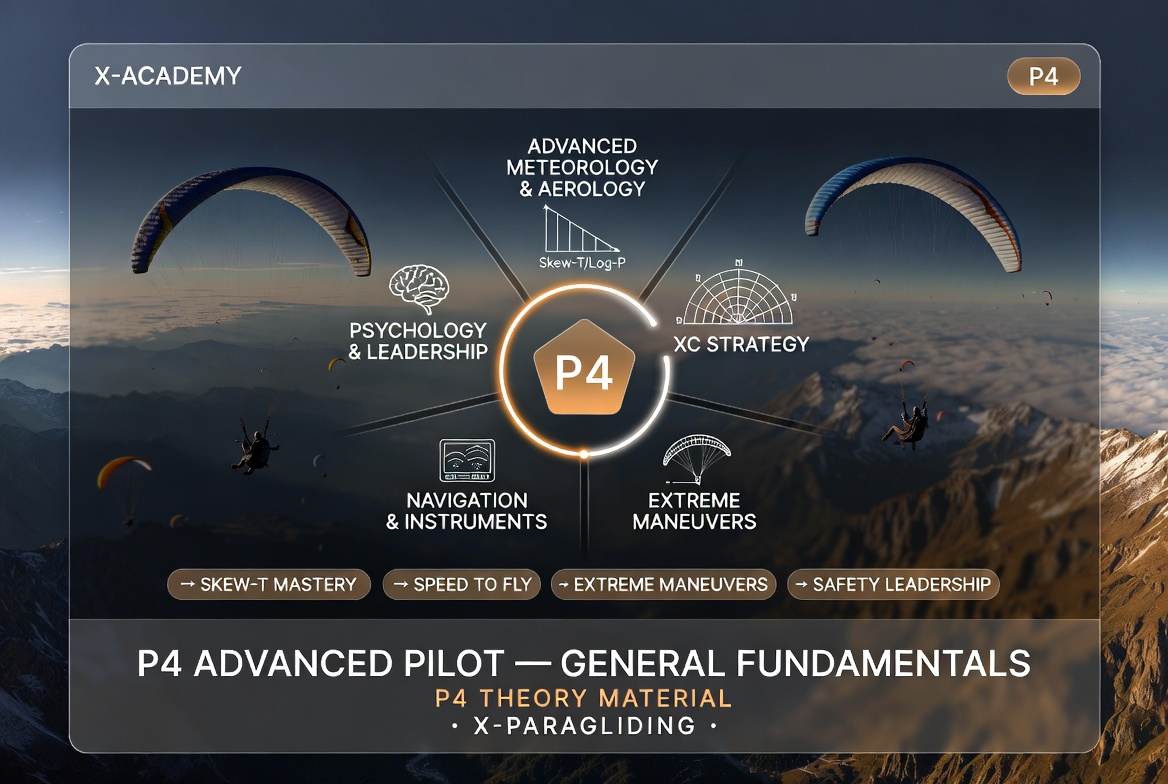
The P4 (Advanced Pilot) level in paragliding represents the pinnacle of a pilot's evolution, where the focus shifts from basic flying to strategic independence. A P4 pilot must be a "chess player of the sky"—capable of predicting complex meteorological processes, planning multi-hour Cross-Country (XC) routes, and managing any critical situation with composure.
Here is the detailed English translation of the core P4 theoretical syllabus:
1. Advanced Meteorology and Aerology
A P4 pilot does not rely solely on pre-made forecasts; they analyze atmospheric layers themselves.
In-depth Reading of Skew-T / Log-P Diagrams: Precise determination of inversion layers, humidity levels, and thermal potential.
Mesometeorology: Understanding how large mountain massifs and valleys modify general forecasts (local pressure variations).
Frontal Systems: The dynamics of cold and warm fronts and their impact on flight safety.
Convergence Zones: Identifying areas where winds from different directions meet, creating powerful "walls of lift."
2. Cross-Country (XC) Strategy
This is the core essence of the P4 level.
Speed to Fly (MacCready Theory): Selecting the optimal speed during transitions between thermals to cover maximum distance in minimum time.
Route Optimization: Utilizing "Cloud Streets" and adjusting the trajectory based on wind direction.
Final Glide Calculation: Mathematical estimation of whether current altitude is sufficient to reach the goal.
Terrain Reading: Visual analysis of unfamiliar terrain to predict thermal release points.
3. Flight Safety and Extreme Maneuvers
The pilot must possess the highest level of wing control.
Advanced SIV Theory: Understanding Full Stall, Tail Slide, and their use in restoring wing configuration.
Deep Spiral Dive: Managing high $G$-forces and ensuring a safe exit.
Incident Prevention: Predicting turbulence based on terrain shapes (e.g., Lee-side turbulence).
4. Navigation and Digital Instruments
Flight Computers & Apps: Advanced use of XCTrack, SeeYou, and other professional software.
Airspace & Law: International air law, reading NOTAMs, and strict adherence to air corridors.
FAI Rules: Competition formats and rules for measuring distances (Triangles, Out and Return).
5. Psychology and Risk Management
Decision Making under Pressure: Making critical choices under conditions of fatigue and hypoxia (during high-altitude flights).
Overcoming "Intermediate Syndrome": Preventing errors caused by overconfidence.
Safety Culture: Acting as a lead pilot and setting a safety example for others.
6. Advanced Equipment Knowledge
Wing Certification: Specifics of EN-C and EN-D class wings (2-liner vs. 3-liner technology).
Harness Geometry: How the geometry of the harness affects wing stability and feedback.
Use of Ballast: The impact of wing loading (weight) on speed and stability.