

On this page
For a P4-level pilot, psychological preparation is as vital as wing control technique. When a flight lasts 5–7 hours and altitudes reach 3,000–4,000 meters, the primary challenge is no longer aerodynamics, but the management of one’s own mind.
Here is the in-depth English translation of these critical psychological and risk management topics:
1. Decision Making under Pressure
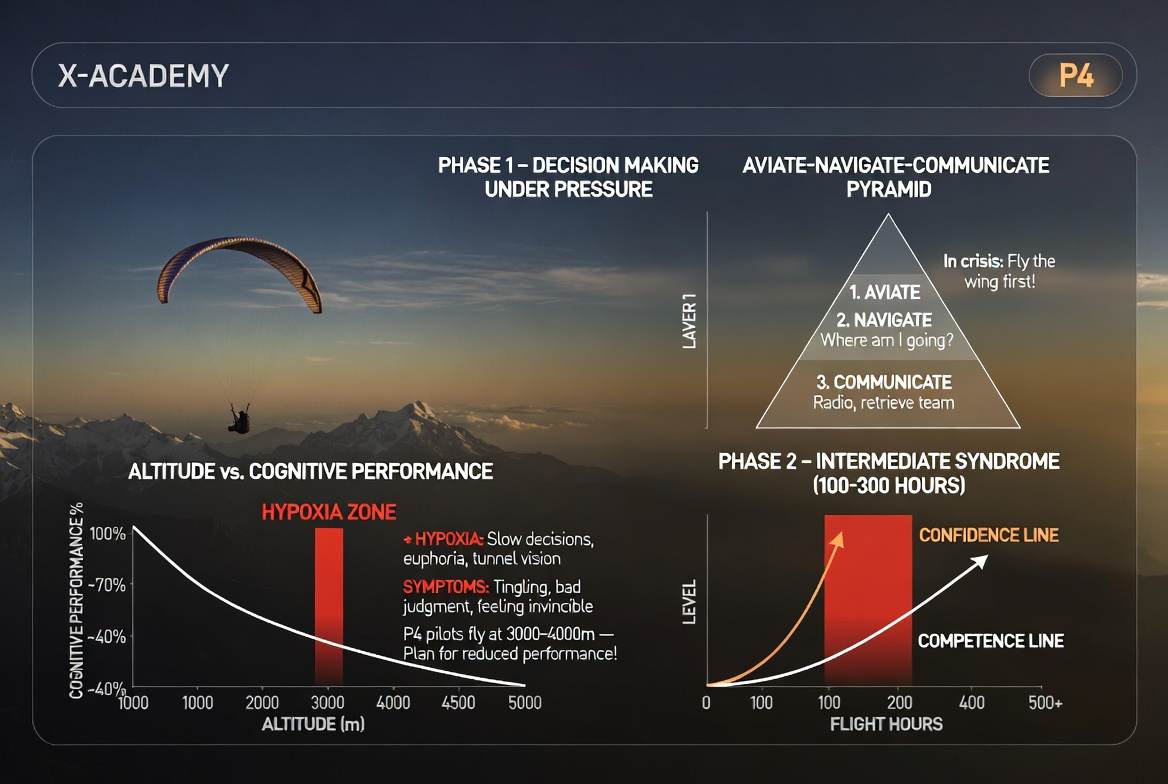
At high altitudes and during long-endurance flights, a pilot's brain operates in a restricted capacity.
Hypoxia and Fatigue: Above 3,000 meters, the air thins, leading to hypoxia (oxygen deprivation). Symptoms—such as slowed reactions, euphoria, or conversely, apathy—are often invisible to the pilot themselves. A P4 pilot must recognize their body’s personal warning signs and have "automated" action plans ready in advance.
Conserving Cognitive Resources: In high-stress situations (e.g., strong turbulence during landing), an exhausted brain is prone to error. At the P4 level, a pilot learns to prioritize using the Aviate, Navigate, Communicate hierarchy.
2. Overcoming "Intermediate Syndrome"
This is the most dangerous psychological phase in paragliding, typically occurring in pilots with 100 to 300 flight hours.
The Illusion of Invincibility: The pilot begins to feel they have mastered the sport because they have successfully navigated a few tricky situations. This leads to a reduction in the Safety Margin—flying in stronger winds or over more hostile terrain.
Prevention: A P4 pilot understands that "luck" is not "skill." They constantly perform critical Debriefing of their flights, asking: "Was the fact that the wing didn't collapse due to my input, or was I just lucky?"
3. Safety Culture and Leadership
A P4 pilot is an authority figure in the community. Their behavior defines the safety standards for the entire group.
Leadership Responsibility: If an experienced pilot launches in questionable conditions, beginners will likely follow, despite lacking the appropriate equipment or skills. A P4 pilot must have the integrity to say publicly: "I am not flying today; the conditions exceed my personal limits."
Risk Management Matrix (PAVE): Before a flight, the pilot evaluates three core factors: Pilot (physical/mental state), Aircraft (equipment airworthiness), and Environment (weather and terrain). If even one factor is questionable, the total risk increases exponentially.
Why is this important?
At the P4 level, the greatest danger is not nature, but the pilot's ego. Mastery means not only flying in difficult conditions but also knowing exactly when to land or when not to unpack the wing at all.