
Reserve Parachute Repacking — Theory Test
18 questions4 errors allowed
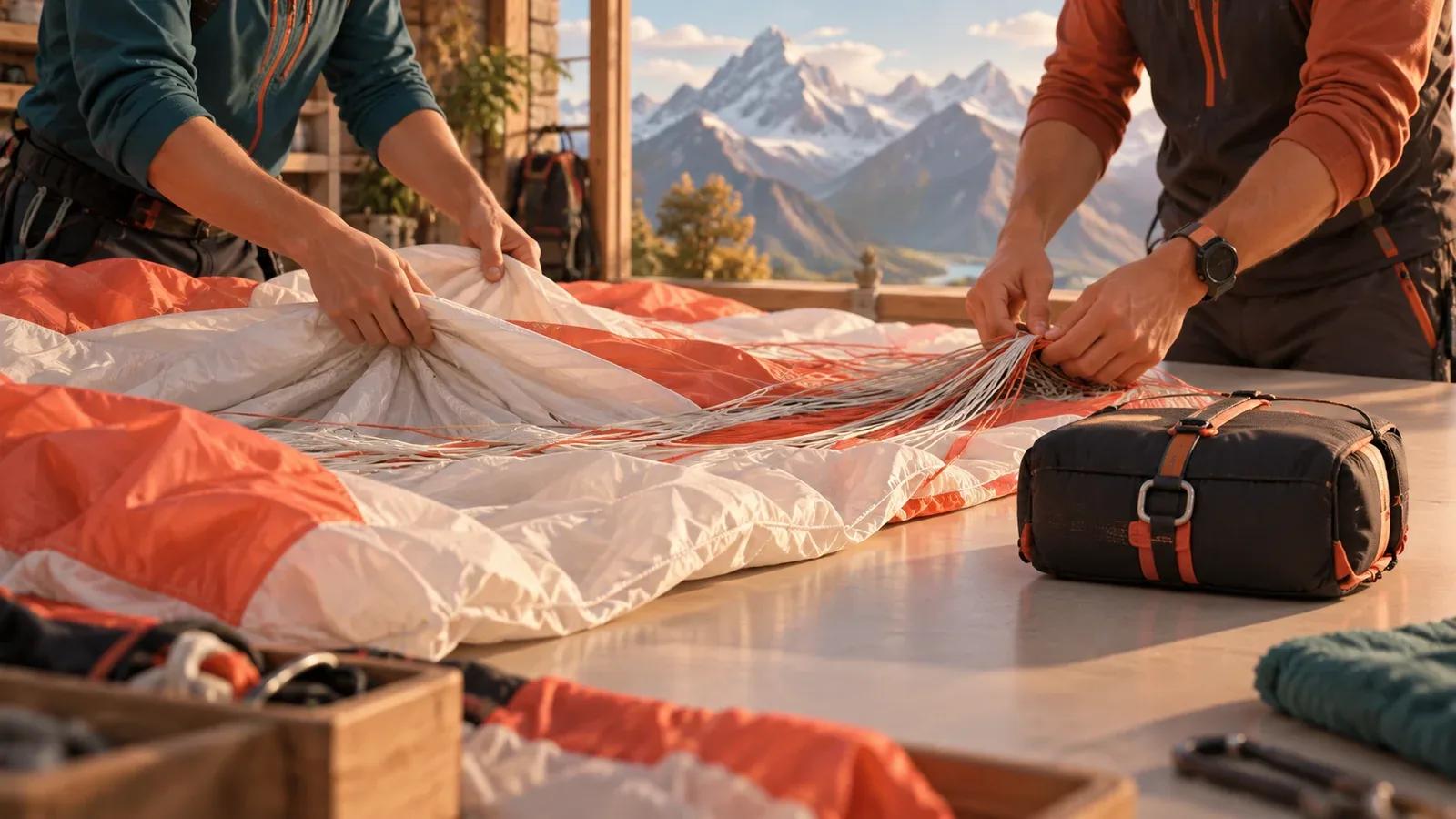
Repacking a paragliding reserve parachute is one of the most critical components of flight safety. According to international standards (FAI, APPI, DHV), a reserve parachute must be repacked at least once or twice a year (every 6 months) to prevent fabric deformation and ensure minimum deployment time. Main standards and training stages to be observed during the repacking course: 1. Environmental Standards Repacking cannot be done just anywhere. The standard requires: Clean and dry surface: Ideally a special table or a clean floor (without carpet, to avoid static electricity). Low humidity: The environment must be dry to prevent the fabric from absorbing moisture, which subsequently causes the parachute to become "sticky." Lighting: High-quality lighting so that the pilot can detect damage to each line and the fabric. 2. Training Stages (Course Curriculum) Stage I: Inspection Before repacking begins, the student must learn to perform a detailed check: Fabric integrity: Searching for holes, burns, or chemical stains. Line check: Ensuring they are not frayed or tangled. Ventilation: The parachute must be hung in an open state for at least 6-12 hours before repacking to allow the fabric to "breathe" and release moisture. Stage II: Symmetry and Flaking Dividing the parachute into sections according to the manufacturer's instructions. Maintaining symmetry: Each panel must lie perfectly straight so that the airflow acts uniformly during opening. Stage III: Lines Organization This is the most responsible part. Lines must be arranged in a figure-eight pattern (S-folds) so that they do not become entangled during opening. The use of special rubber bands that do not melt over time and do not damage the lines. Stage IV: Deployment Bag Packing Placing the parachute into the inner container so that when the handle is pulled, the lines come out first and then the canopy unfolds. 3. International Standards and Certification Manual Compliance: The main standard of the repacking course is - "Follow the manual." Different types of parachutes (round, square, Rogallo) have different repacking specifics. G-Force Test: During training, the pilot must know that in a real situation, centrifugal force makes throwing more difficult; therefore, the course includes "practice throws" on a special simulator. Certified "Repacker": In many countries, a pilot does not have the right to repack the parachute themselves unless they have completed the relevant course and hold "Licensed Repacker" status. 4. Required Equipment for Training During the course, the pilot must have: Their own reserve parachute and harness. Special folding weights. New elastic rubber bands (Replaceable rubber bands). A checklist for each step of the repacking process. Summary: A reserve parachute repacking course is not just "packing." It is an engineering process where there is no room for error. After completing the course, the pilot must know not only how to repack but also how to check the carabiners and "soft links" connecting the parachute to the harness.